
While cannabis represents a massive, multi-billion-dollar global market, many cannabis-related roles do not follow a single standardized education pathway. Regulatory frameworks continue to shift across different jurisdictions, leaving a fragmented landscape facing professionals interested in entering the field.
That leaves a rather simple, yet important question to answer: what’s the best credential you can pursue to achieve the career goals you’re seeking, and is a cannabis science certificate worth it?
The answer: if you’re a science-trained learner, a graduate cannabis science certificate may offer value by helping you build structured knowledge in cannabis biology, chemistry, pharmacology, testing, quality control, regulation, and therapeutic applications. It may be less valuable if you’re only looking for basic retail and cultivation training and don’t need a deeper understanding of the regulatory landscape.
Cannabis education options vary widely. Some programs are short, low-cost, and focused on retail, cultivation, business, or general cannabis knowledge. Others, like Northeastern University’s Graduate Certificate in Cannabis Science, are graduate-level and science-forward. To decide if a cannabis science certificate is a good investment for you and which option is best, here are tips for evaluating the cost, credential value, program quality, and career fit.
What Do You Actually Get From a Cannabis Certificate?
As an industry, cannabis science is still developing, and growth is happening state by state and country by country at different rates. Experienced professionals often become involved with cannabis studies through adjacent fields or therapeutic use, not a planned career path. Cannabis educational programs vary in content and depth, meaning students don’t have a clear model to follow but are free to choose their own path.
With all of this in mind, it’s beneficial to have a clear idea of what you hope to achieve by earning a certificate. Different cannabis certificates offer different types of value to students. Consider whether any of the following factors apply to you.
Structured knowledge
A certificate organizes the cannabis field into a coherent learning path. Structured knowledge is valuable in a field where information may be fragmented across trade publications, companies, regulators, patient communities, and scientific literature.
Dr. Miyabe Shields, PhD, a Northeastern graduate, cannabis science educator, and structural biochemist by training, points to the ambiguity students face when deciding where to focus their efforts.
“So if we talk about what cannabis is, the first question is: what is cannabis science? It is super broad; it’s everything from seed to sale, and there’s a scientific component in pretty much every place.”
Shields likens cannabis science to other disciplines like food science or aerospace, noting that it branches into sectors such as research, policy, regulatory law, pharmacology, and botany. Each of these subject areas has academic and applied subdisciplines, such as horticulture, hybridization, and safety testing.
Look closely at the curriculum a certificate offers and its intended audience. Some programs are targeted to students without a scientific background, while others, such as Northeastern’s certificate, build upon subject knowledge in chemistry, biology, and other sciences.
Scientific or technical foundation
Working in the industry long-term requires knowledge of cannabis properties, how it affects the body, and the many ways it can be used. For science-forward programs, learners can gain grounding in:
- Cannabis Biology: The study of cannabis genetics and biological properties as well as how it interacts with human biology and the environment.
- Chemistry: The study of chemical compounds in cannabis and how they can be synthesized or combined with other components to produce specific traits or effects.
- Pharmacology: A deeper study of how cannabis interacts within the body, such as its side effects, absorption rates, metabolic properties, and therapeutic benefits.
- The Endocannabinoid System: The study of specific enzymes, receptors, and chemicals in the body that regulate functions like memory, stress, temperature, and appetite.
- Testing and Product Quality: The analysis of cannabis plants and derived products to understand factors such as composition, purity, and potency.
- Therapeutic Applications: The study of potential therapeutic uses, limitations, risks, and evidence related to cannabis and cannabinoids.
Shields describes cannabis as one of the most hybridized plants, and cannabis genetics as an expansive subject on its own. However, Shields also explains that, with so many unexplored or inadequately researched areas, such as smoke science, students invested in pursuing a career in the industry will have multiple options.
Yet, an interdisciplinary understanding of cannabis science is necessary to explore many emerging areas of study. “Being in early and having the credentials early just means that you will have the opportunity to transition and grow and do a whole bunch of different things,” Shields says.
Credential value
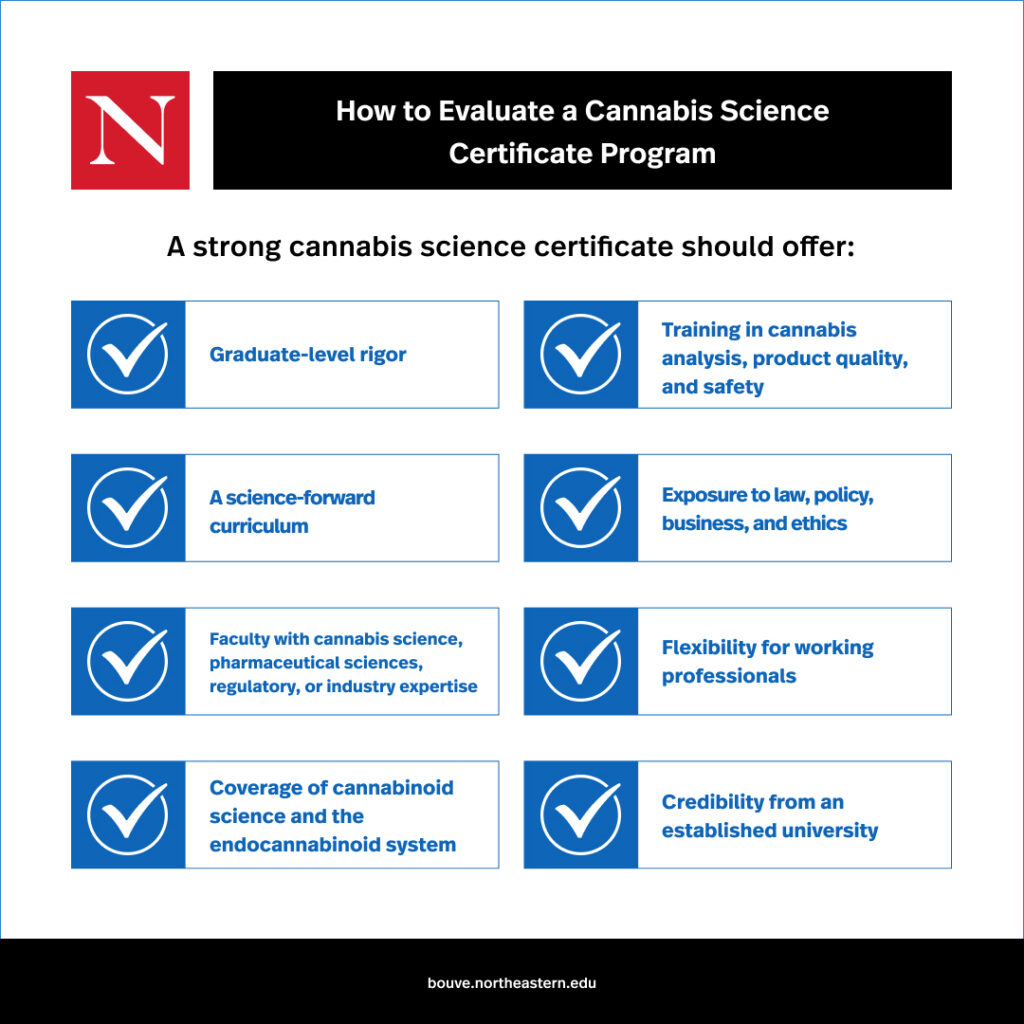
A certificate from a recognized university may signal a more serious level of preparation than a short informal training course. However, credential value depends on the program’s rigor, institution, curriculum, and relevance to the learner’s goals. Programs that include a lab component or co-op, for example, provide a way for students to apply what they’ve learned and demonstrate their skills on a resume.
Another important consideration is institutional credibility. Look for whether the program is offered by an accredited university, whether it is credit-bearing, and whether the curriculum is taught by faculty or professionals with relevant scientific, regulatory, or industry expertise.
When comparing programs, research the overall credibility of the faculty and educational institution. Some helpful questions to ask would include:
- Do the instructors work in the cannabis industry or have substantial past experience?
- Does the department or organization offering the program have a reputation for being innovative and supporting ground-breaking research?
Career clarity
Obtaining a graduate certificate allows you to dig deeper into cannabis-related topics and decide which areas of the industry fit your background and interests. Fields such as testing, compliance, and product development may appeal to students interested in creating more cannabis-derived products, measuring their safety, and navigating the FDA approval process.
Students who are passionate about medical cannabis may want more evidence-backed information about its capabilities, limitations, and risks to educate themselves and others.
Some students may want to work in policy, education, marketing, or industry leadership, all of which require the ability to communicate accurate, actionable information about the genetic diversity of cannabis and its potential effects on humans.
Professional confidence
Formal education can help learners communicate more confidently about cannabis science, product quality, safety, and regulation. Shields acknowledges that misinformation about cannabis can be a problem at times, especially because scientists are underrepresented on the consumer-facing side of the cannabis industry.
“A lot of people are super passionate and they do their own research. They get a lot of information out of it, and you end up being able to understand a little bit more the line between hard science and community knowledge—which is valuable and important but it’s different.”
As Shields points out, building a science foundation gives students the insight to distinguish between informal claims and rigorous evidence. “Formal training in the sciences helps you understand the technical aspect of things that we didn’t apply to cannabis until the last 20 years.”

What Makes a Graduate Cannabis Science Certificate Different?
Cannabis education encompasses a variety of topics ranging from plant genetics to dispensary supply chain management. Different programs emphasize specific subjects in their curriculum based on their institutional focus. Common focus areas include:
- Retail or budtender training: Budtending and retail education involve customer-facing functions at licensed dispensaries, such as maintaining inventory and answering product questions.
- Cultivation certificates: Cultivation programs teach the principles of growing, harvesting, and processing cannabis plants.
- Cannabis business programs: Business-focused programs equip students to run a legal cannabis operation, managing functions such as inventory, financial reporting, marketing, quality assurance, licensing, and compliance.
- Medical cannabis education: Using evidence-based research, health-focused programs teach the pharmacological science of cannabis and its clinical applications. These programs emphasize topics such as dosage management, patient safety, treatment monitoring, and ethical responsibility.
- Compliance-focused programs: Compliance education helps students understand state, provincial, and federal regulations of cannabis and develop processes to comply with changing standards, such as proper testing, product labeling, recordkeeping, advertising, and environmental responsibility.
- General cannabis certificates: Generalized programs typically offer a comprehensive intro to cannabis studies, providing foundational knowledge of the history, biology, cultivation, processing, and regulation of cannabis.
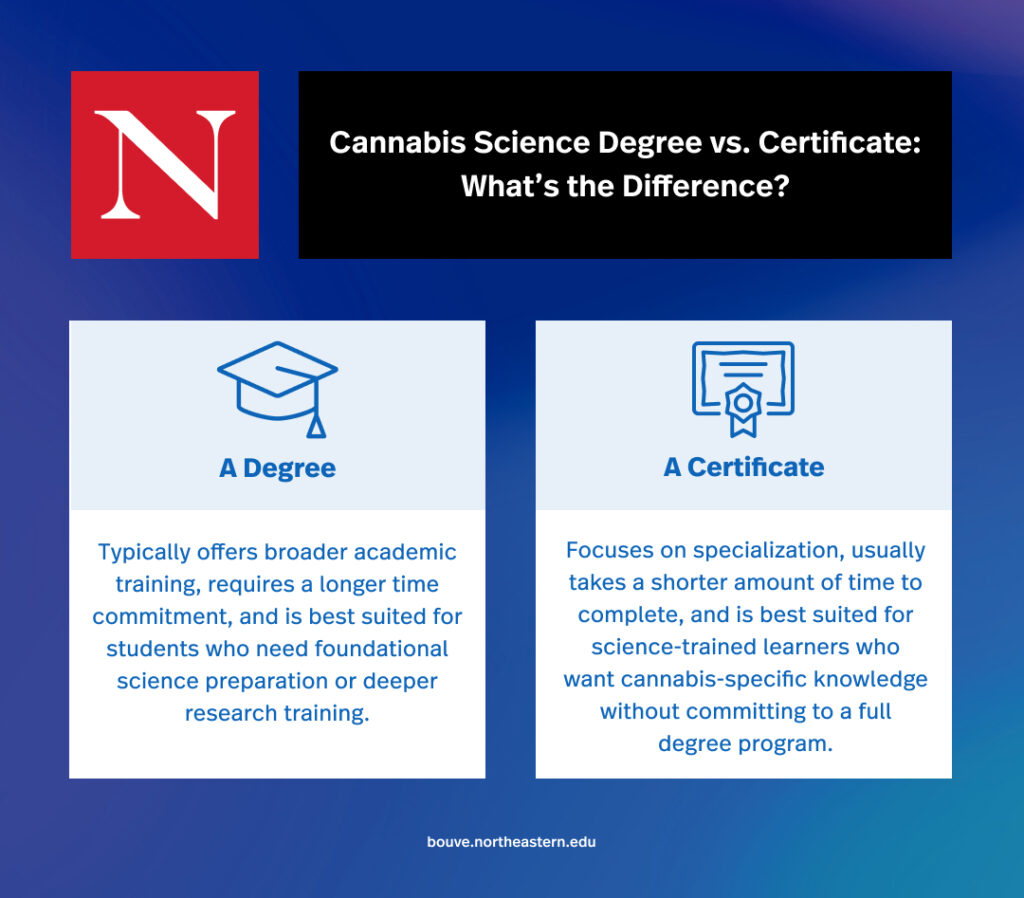
A graduate cannabis science certificate differs from other program options because it’s designed for learners who want deeper scientific and interdisciplinary knowledge. For instance, Northeastern’s Graduate Certificate in Cannabis Science focuses on the chemical, biochemical, pharmacological, scientific, health, and therapeutic aspects of cannabis.
Northeastern’s program is 100% online, available for full-time or part-time enrollment, and can be completed in as few as nine months. The curriculum goes beyond basic cannabis terminology; it provides a foundation in compliance, safety, and regulatory standards and includes cannabis history, business, law, and policy.
Students build analytical and research skills by developing a more rigorous understanding of how cannabis products are studied, tested, regulated, and applied. The program explores the human endocannabinoid system and evidence-based medicinal and clinical implications, introducing learners to emerging topics of research.
How Should You Evaluate the Cost of a Cannabis Certificate?
When considering the cost of a cannabis certificate, evaluate the program within the context of your goals, timeline, and resources. Here are key questions to answer as you weigh the cost of a cannabis certificate:
- What is the total tuition?
- Are fees included?
- Is the program credit-bearing?
- Is it graduate-level?
- How long will it take?
- Can you complete the program while working?
- Does the curriculum match your goals?
- Does the program provide the level of scientific depth you need?
- What alternatives are you comparing it against?
- What would you lose by choosing a cheaper but less relevant option?
- Does your employer offer tuition assistance or professional development support?
Working while studying can affect your learning pace, making it helpful to choose a program with part-time enrollment options. If you’re already employed in the cannabis industry, a tuition assistance program may reduce your educational costs and enable smoother career advancement after completion.
Taking all these factors into account, consider whether you can address your most important educational goals with one program or would need other coursework as well.
How Should You Evaluate Career Fit?
One challenge you may face when navigating the cannabis industry is that career paths are not equally standardized. Some roles, especially testing and compliance roles, are more defined, while other opportunities are emerging as the industry matures.
A cannabis science certificate may be a strong fit if you want to explore:
- Product testing
- Quality assurance or quality control
- Regulatory compliance
- Medical cannabis education
- Cannabinoid research
- Public health
- Policy or health law
- Product development
- Formulation
- Drug development
- Processing or extraction science
- Industry leadership
- Science communication
- Advancement within an existing cannabis company
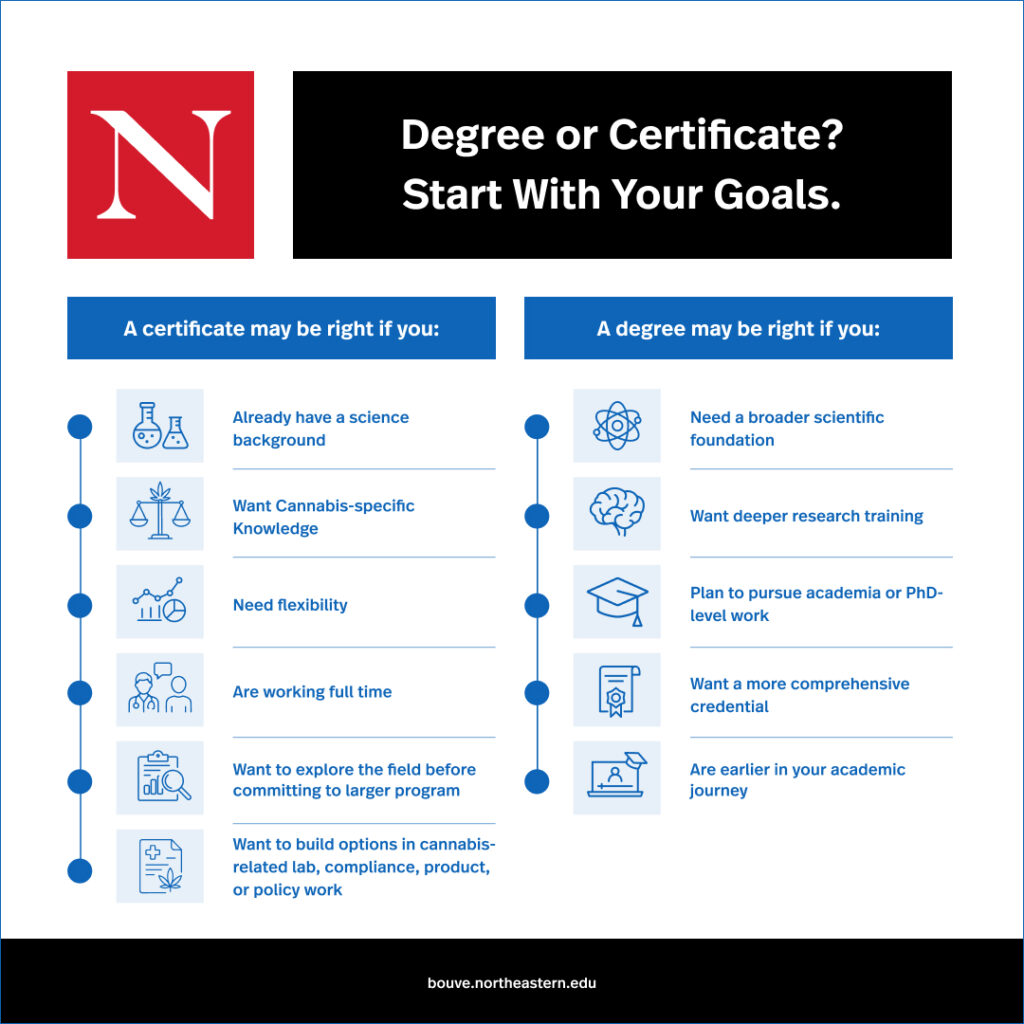
Science-forward certificates may be best suited for you if you already work in the cannabis industry or another science field. Gaining specialized cannabis knowledge may benefit you if you’ve hit a ceiling professionally or want to move from cultivation into lab roles, corporate, policy, or more technical work.
“I think the main market is people who had entry-level jobs in the industry and are thinking, ‘I want to climb. I want to be on the corporate side. I want to be on the global side. I want to be on the policy side. I want to work in a lab,’” Shields says.
When Is a Cannabis Certificate Not Worth It?
A cannabis certificate isn’t the only option for furthering your education, and it might not be the right fit if you want a basic retail credential or cultivation-only training. Shields encourages potential students to take a clear, objective look at cannabis-related fields before investing in education.
Some people are drawn in by trends and do not stay in the industry, which is very competitive overall. Companies also have to work through constantly fluctuating legal changes that influence their revenue and how they’re allowed to operate.
Long-term fit in the cannabis industry depends on more than earning a credential. It often requires genuine interest in the field, a willingness to keep learning, and the ability to apply scientific knowledge to real-world operations. Professionals who continue asking new questions, collaborating across disciplines, and working toward more transparency in cannabis science may be better positioned to adapt as the field evolves.
“Stability and longevity in the industry are built on whether you want to be there and if you’re going to pivot,” Shields explains.
“What a certificate and what education gives you are more options typically,” they say.
Should You Pursue a Cannabis Certificate?
Earning a cannabis certificate is worth considering when it clearly matches your goals. A compatible certificate program should help you answer these questions: What part of the cannabis field do I want to work in? What level of scientific depth do I need? Will the program give me knowledge I can actually use?
Not all programs are created equally, and having the word “cannabis” on the credential doesn’t automatically make it valuable. The certificate’s value depends on how well the curriculum prepares you to understand the field more deeply and move toward the career opportunities you want.
While a short training program is beneficial for some learners, a graduate-level certificate with science-forward training is a more appropriate option for expanding technical and analytical skills.
For science-trained learners who want a rigorous, online path into cannabis science, Northeastern’s Graduate Certificate in Cannabis Science offers a structured way to study the field’s scientific, therapeutic, regulatory, and product-related dimensions. But the best next step is to evaluate how the curriculum fits your background, goals, and timeline.
Want to learn more about Cannabis Science Graduate Certificate?
Request more information about the certificate and any questions you might have.