
When most people hear about “cannabis industry careers,” the first things that come to mind are dispensaries, cultivation, sales, or entrepreneurship. Planting and retail are the visible parts of the industry, but they don’t tell the full story—especially for science graduates.
If you have a scientific background, you may wonder if your science education actually matters in cannabis fields. Given how new and uncertain the industry can be, are there “serious” cannabis careers beyond retail or cultivation? Where would biology, chemistry, pharmaceutical sciences, health sciences, lab, or public health experience fit?
Science graduates not only fit into the cannabis industry—in areas such as product testing, quality control, compliance, cannabinoid research, medical cannabis, product development, public health, policy, and industry education—but the need for such experience is only growing. Scientific training can help professionals bring rigor to product safety, evidence, regulation, and innovation.
The safe use of cannabis depends on thorough studies of human and plant biology and how they chemically interact. Here, we’ll look at how science-trained professionals can pursue a career in the growing field of cannabis science, while prioritizing public health.
Cannabis Industry Careers Go Beyond Retail and Cultivation
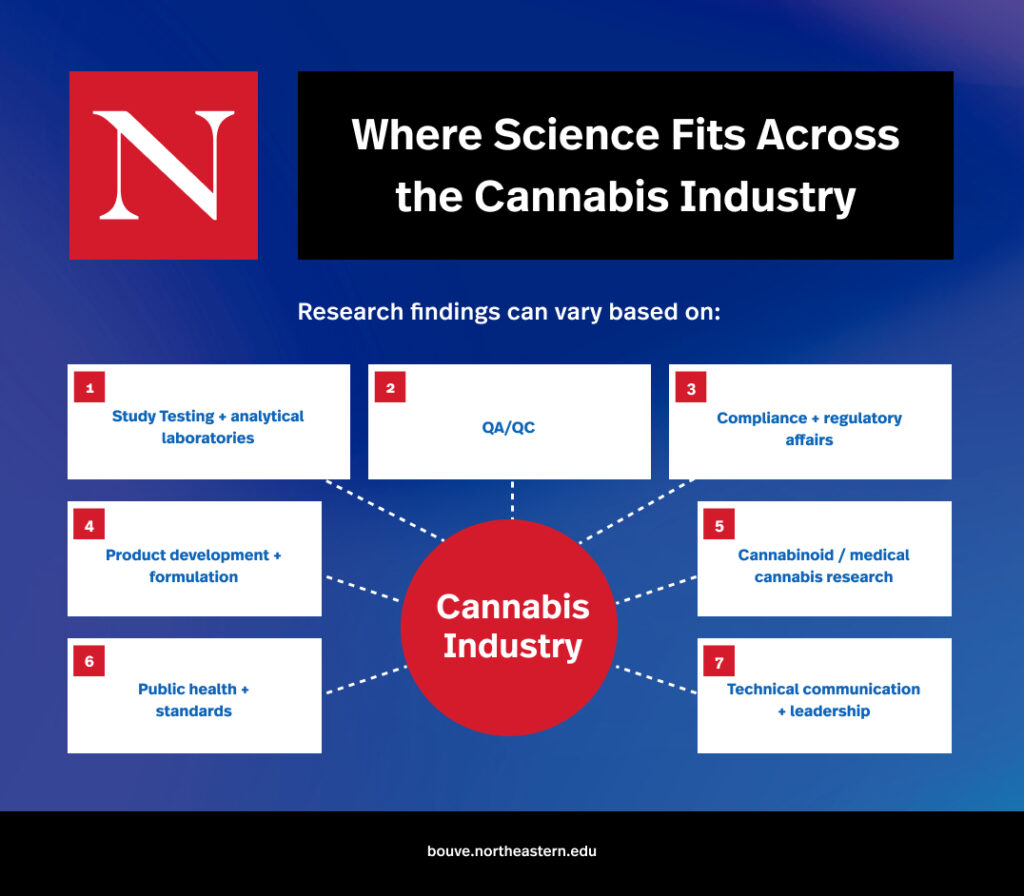
Many cannabis careers are publicly visible because they’re consumer-facing: dispensaries, budtenders, cultivation facilities, sales, or brand work. Yet, the industry also depends on less visible technical and scientific functions.
“I think the misconception about the cannabis industry is that everything is cannabis-centric…Everything revolves around the plant and around the product,” says Miyabe Shields, PhD, a Northeastern graduate, cannabis science educator, and structural biochemist by training. “But the reality is…it’s an industry that is huge, massive, and growing at the global level.”
Shields likens cannabis science to food science because both fields draw on multiple scientific disciplines and apply that knowledge across research, product development, safety, quality, and commercialization. Cannabis science consists of complex observation, experimentation, hypothesis testing, and evidence, and these functions feed into all the commercial components on the consumer-facing side.
In product development fields, scientists work in extraction and processing, separating cannabinoid compounds from the base plant. Through product testing, producers can measure potency, characterize aroma and flavor profiles, assess consistency, and detect contaminants or other potentially harmful substances. Through formulation processes, scientists combine cannabinoid compounds and other ingredients to make beverages, edibles, and capsules.
Scientific testing also shapes regulatory compliance, quality assurance, and quality control fields. State regulatory agencies develop product standards and safety guidelines that cannabis producers must follow.
By studying cannabis composition, scientists can determine how to properly handle cannabis products at different stages of development and identify unsafe levels of substances like pesticides or heavy metals.
Those interested in new or refined applications of cannabis may work in cannabinoid research jobs, which inform policy and public health. Having a strong scientific foundation is also useful for medical cannabis education, technical consulting, or science communication—roles that involve communicating evidence, product safety, regulatory information, or technical guidance to consumers, clients, organizations, or healthcare-adjacent audiences.
Why Does the Cannabis Industry Need Science Graduates?
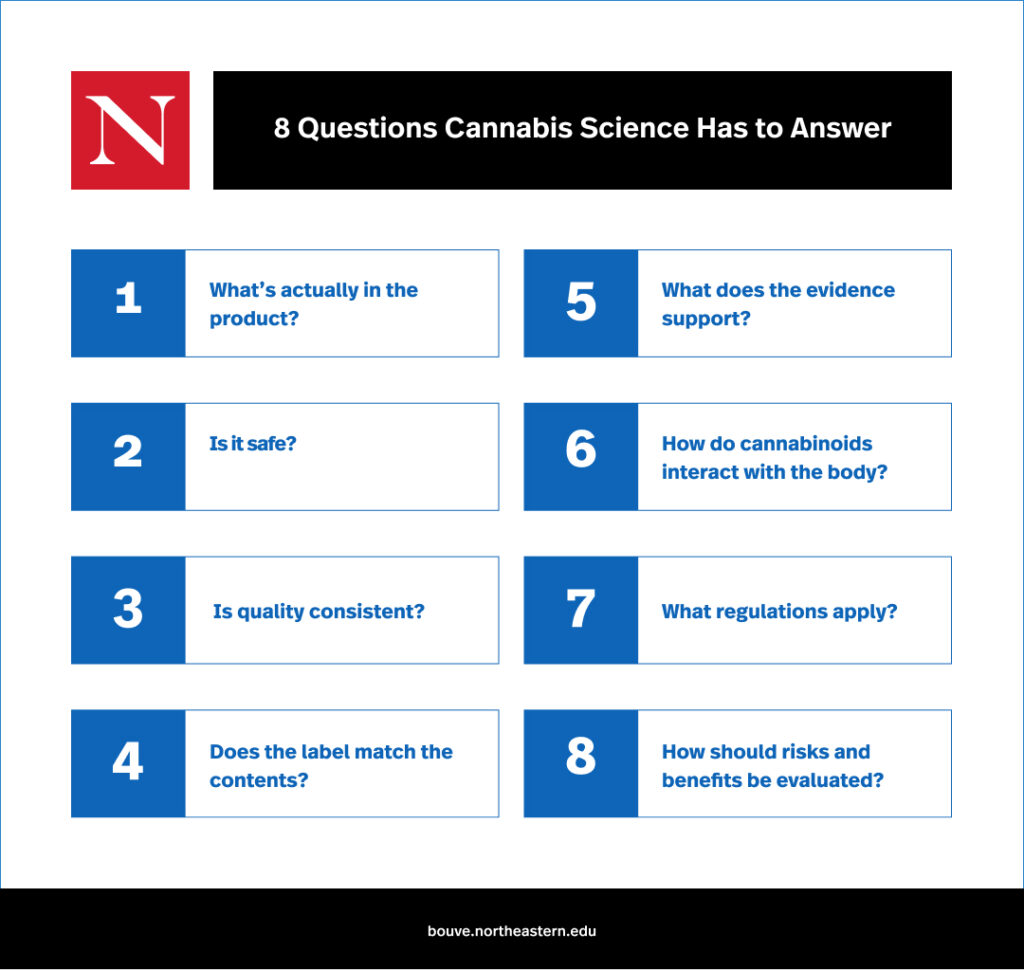
The cannabis industry is maturing and needs people who can help answer scientific and technical questions, such as:
- What is in the product?
- Is the product safe?
- Is the product quality consistent?
- Does the label match the contents?
- What does the evidence support?
- How do cannabinoids interact with the body?
- What regulations apply?
- How should products be developed, tested, and communicated?
- How should risks and benefits be evaluated?
Scientific literacy is increasingly important to drive progress and solve industry challenges because cannabis sits at the intersection of several complex sectors and disciplines.
- Consumer products: Cannabis-derived consumer products may require testing for composition, contaminants, stability, labeling accuracy, and other safety or quality factors depending on the product and regulatory market.
- Medicine and health claims: Professionals need evidence about potential benefits, risks, limitations, product variability, and patient safety when evaluating medical cannabis or cannabinoid-related claims.
- Agriculture: As cannabis markets grow nationally and globally, producers will need to develop better cultivation and hybridization methods, manage pesticide use and environmental impact, and promote sustainable practices.
- Pharmaceutical science: Developing cannabinoid-based drug products requires research into pharmacology, formulation, dose, safety, efficacy, quality, and clinical outcomes.
- Food and beverage formulation: Cannabis-infused consumables raise formulation, stability, dosing, labeling, ingredient compatibility, manufacturing, and regulatory questions that require scientific and technical expertise.
- Public health: Scientists aid in protecting public wellbeing by educating stakeholders about cannabis products and controlling product quality and consistency through research, testing, policy, and regulation.
- State and federal regulation: Scientific evidence about cannabinoids, product safety, public health, and cannabis biology can inform regulatory standards and policy decisions.
- Product safety: Scientists study cannabis composition, contaminants, and product characteristics, generating evidence that can inform testing standards and regulatory safety thresholds.
- Social and ethical question: Policymakers and educators continually explore the broader societal impact of the legal cannabis industry, such as combating underage use, promoting responsible marketing, and finding a balance between personal freedom and public safety.
In an emerging industry, science graduates won’t always be able to step into predefined roles. Instead, they may help define better standards, improve product quality, build evidence, and shape how the field matures.
Northeastern University’s Graduate Certificate in Cannabis Science speaks to these objectives with coursework that helps students build scientific foundations, gain analytical and research skills, understand therapeutic applications, and evaluate social and ethical responsibility.
What Science Backgrounds Transfer to Cannabis?
From horticulture to biochemistry to pharmacology, scientific processes and analysis are the backbone of the cannabis industry. While the public often views cannabis as simply a therapeutic or recreational substance, cannabis studies and experimentation are helping scientists from diverse disciplines explore the plant’s wider capabilities and applications.
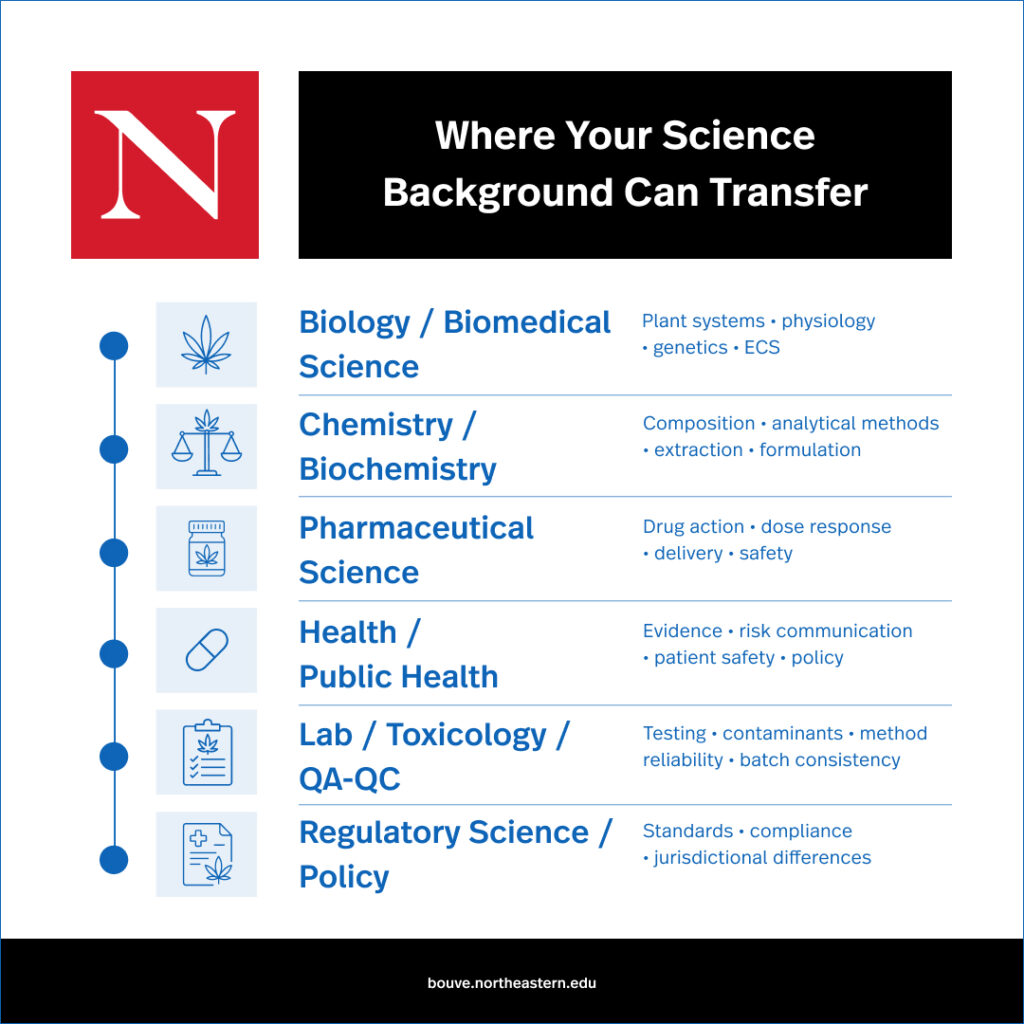
- Biology and biomedical sciences: Biology and biomedical science training can provide a foundation in plant systems, human physiology, genetics, cellular processes, cannabinoids, and the endocannabinoid system. These concepts are relevant to understanding both the cannabis plant and how cannabis-derived compounds interact with biological systems.
- Chemistry and biochemistry: Chemistry and biochemistry backgrounds provide experience with chemical composition, molecular interactions, analytical methods, extraction, formulation, and contaminants—all important concepts when studying cannabis plants and derived products.
- Pharmaceutical sciences and pharmacology: Pharmaceutical science and pharmacology training can help professionals understand drug action, dose-response relationships, delivery methods, metabolism, safety, and the clinical implications of cannabinoid interactions with the body.
- Health sciences, public health, and clinical backgrounds: These backgrounds can provide experience evaluating evidence, communicating health risks, considering patient safety, and understanding how policy and population-level health concerns shape medical cannabis discussions.
- Lab sciences, toxicology, and QA/QC: Laboratory, toxicology, and quality backgrounds provide transferable skills in analytical testing, contaminant detection, method reliability, documentation, batch consistency, and product safety.
- Regulatory science, policy, or health law: These backgrounds provide experience interpreting regulations, evaluating standards, understanding compliance requirements, and navigating differences between jurisdictions.
Where Can Science Graduates Fit in the Cannabis Industry?
As Shields notes, “there’s a scientific component in pretty much every place” when it comes to cannabis science. Cultivating the plant, studying its strains, extracting compounds and processing the plant, formulating the substances into new products, analyzing each phase for improvement—it all depends on scientific procedures.
If you have experience in relevant science disciplines, here are common environments and roles that may align with your background and skills.
Testing laboratories and analytical science
In regulated markets, testing laboratories may measure cannabinoid potency and screen for contaminants such as microbes, residual solvents, pesticides, and toxic elements to determine whether products meet applicable state requirements.
Analytical scientists study the chemical profile of cannabis, measure its compounds, detect harmful substances, and continually develop better analytical methods.
According to Shields, testing labs are a major industry sector and one of the most common entry-level paths into cannabis science careers. Testing laboratories are among the more structured parts of the cannabis industry because regulated markets commonly establish requirements for potency, contaminants, labeling, and other product characteristics.
Quality assurance and quality control
Quality assurance professionals focus on the systems and procedures used to maintain consistent quality, while quality control professionals evaluate products and processes against defined specifications. In cannabis, that may include documentation, batch review, testing procedures, corrective actions, and consistency across production.
By documenting all of these activities, scientists are able to reduce errors, refine testing processes, and consistently achieve good outcomes.
Compliance and regulatory affairs
Regulation varies by state, and cannabis companies need professionals who understand how product testing, labeling, documentation, distribution, and safety expectations affect operations. Not only do cannabis producers have to follow state and federal laws, but they also need to create accurate records proving their products meet industry standards.
Regulations include rules such as listing the correct cannabinoid measurements by product type, storing and transporting products in safe environments, labeling products with accurate information, and distributing products only through licensed retailers.
Product development and formulation
Science graduates may contribute to edibles, beverages, inhalables, extracts, delivery methods, formulation, processing, and product consistency. In product development, scientists work to extract compounds from cannabis while preserving the aroma, flavor, and other chemical properties. They also test and combine other ingredients, such as stabilizers and sweeteners, to develop cannabis formulations with intended properties while considering stability, consistency, dose, labeling, and product safety.
Shields mentions that cannabis product development exists within a gray area between food science and pharmaceutical science. Product developers have to study how cannabis products affect the body nutritionally, medicinally, and physiologically while also considering how dosage size affects behavior and health. Shields also mentions that smoke chemistry is a growing area of interest, further blurring the lines between food and pharma.
Medical cannabis, cannabinoid research, and education
Science graduates in cannabinoid research may be interested in clinical implications, therapeutic evidence, the endocannabinoid system, or education for healthcare-adjacent audiences. From a clinical and safety perspective, scientists have to consider potential benefits, adverse effects, drug interactions, product variability, and differences across patient populations.
Policy, public health, and standards
Science-trained professionals help shape how cannabis is regulated, studied, communicated, and integrated into public health conversations. An important aspect of their job is to collect significant evidence through research and testing to provide objective views of the overall safety and risk of legal cannabis distribution.
Business, leadership, and technical communication
Even people in corporate, product, investor, or strategy roles can benefit from scientific literacy if they need to make decisions about product claims, safety, regulation, and technical feasibility. Having a scientific background gives professionals in the cannabis industry the insight and terminology to communicate with both technical and nontechnical audiences.
Students with a science background may “enter all different parts of the industry.” Shields shared that, in their personal experiences with students, many graduates have ended up in communication and marketing roles, processing, R&D, education, policy, HR, IT, and leadership. Cannabis-related organizations need operational support at all levels like any other type of business, and people can often perform these roles more effectively with scientific comprehension.
How Can Cannabis Science Education Help?
Cannabis career paths are still less standardized than those in many established scientific industries. Shields compares the cannabis sector to the software industry in the 1990s: a rapidly developing field in which roles, standards, and professional pathways are still taking shape. For science-trained professionals, that makes transferable knowledge especially valuable.
Science graduates may already have important foundational skills, but working with cannabis adds specialized context. Completing cannabis-specific education can provide more in-depth knowledge of:
- Cannabinoid science
- The endocannabinoid system
- Cannabis product analysis
- Testing and quality control
- Therapeutic applications
- Law and policy
- Product development
- Public health and ethics
- Industry-specific terminology and standards
By understanding how these components of cannabis science and the wider industry interconnect, graduates can enter the field with professional confidence.
Northeastern’s Graduate Certificate in Cannabis Science offers a way for science-trained learners to apply their existing knowledge to cannabis topics. The program bridges academia and industry by exploring scientific foundations, analytical and research skills, therapeutic applications, and social/ethical responsibility.
The certificate program is fully online and can be completed in as few as nine months. The multidisciplinary curriculum covers cannabis history, business, law, and policy with a primary focus on chemical, biochemical, pharmacological, scientific, health, and therapeutic aspects of cannabis. Students learn from instructors with direct cannabis industry experience, helping them understand the questions and challenges influencing the industry in real time.
Where Should You Go From Here?
Cannabis industry jobs are diverse and consist of far more than retail and cultivation. Depending on your professional interests and background, science graduates can contribute to product development from seed to sale through roles in product safety, testing, and quality control. Professionals who want to shape the future of cannabis science and commercialization can work in research, regulation, policy, communication, or medical cannabis, advancing knowledge of the plant’s capabilities.
While the cannabis industry doesn’t always offer clearly laid-out paths to follow, Shields explains that flexible career development can be beneficial. “It comes with this amazing roadway where the possibilities are unlimited and expansive, and if you are passionate and if you have the base-level knowledge and if you want to be part of what is a foundational situation, it’s constantly changing and growing. But your impact can be pretty large and your freedom to operate can be pretty large too.”
The field is continually evolving, and rigorous scientific training may help incoming professionals evaluate emerging opportunities and adapt as roles continue to develop.
If the cannabis industry is appealing to you, the next step is to clarify where your background fits and what kind of education you need.
Explore Northeastern’s Graduate Certificate in Cannabis Science to learn how the online program helps science-trained learners build a foundation in cannabis science.
Want to learn more about Cannabis Science Graduate Certificate?
Request more information about the certificate and any questions you might have.