Searching for online cannabis certificate programs can quickly become confusing. Programs may use similar language while varying in content and being designed for very different learners.
Dispensary staff, cultivators, business owners, healthcare professionals, compliance professionals, and science graduates all have different goals and needs. Not to mention, some learners simply have a recreational interest in cannabis and don’t plan to work in the industry.
When seeking cannabis education for career purposes, the diversity of options may leave you with more questions: Should I choose a cannabis science certificate? Medical cannabis certificate? General online cannabis certificate? How do I know which one is credible and relevant to my goals?
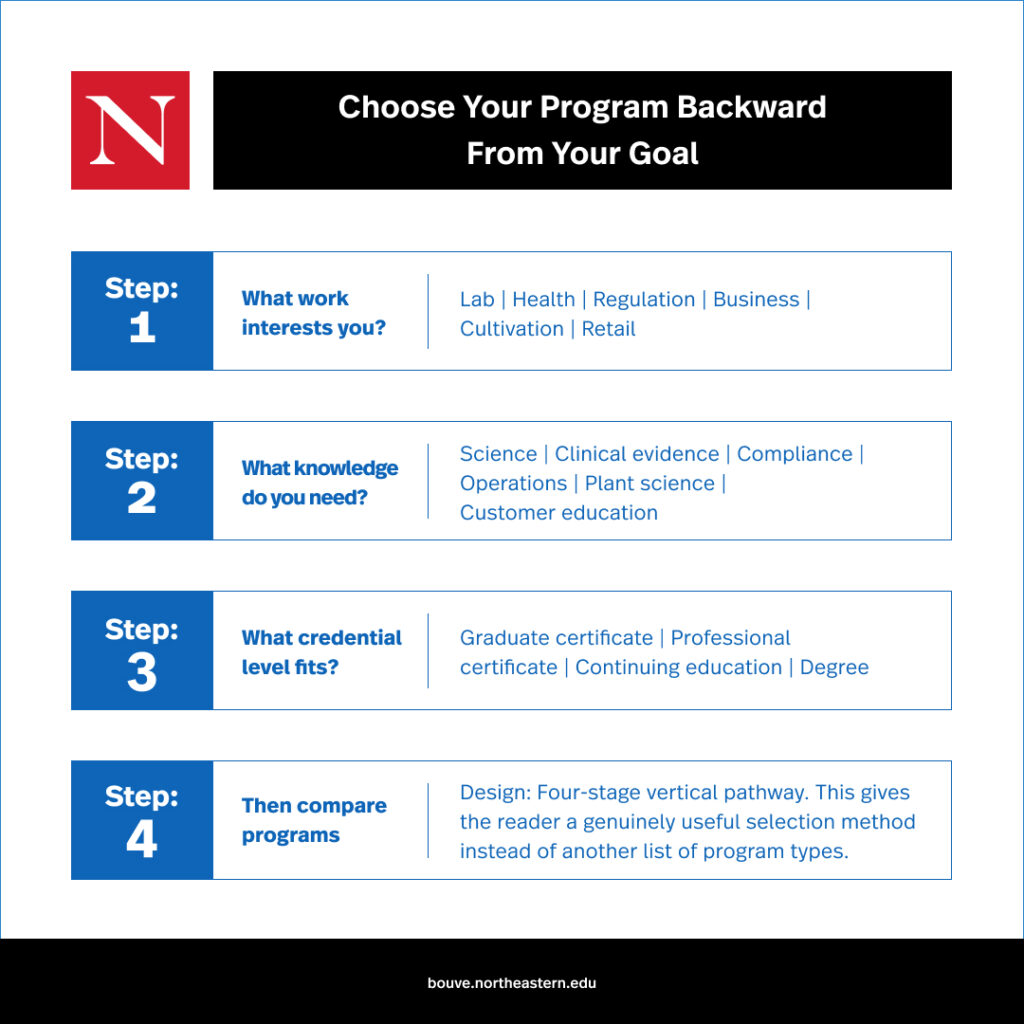
The right cannabis certificate program depends on your background, career goals, and the type of cannabis work you want to pursue. A science-focused certificate is best for learners interested in cannabis biology, chemistry, pharmacology, testing, quality control, medical applications, policy, and product development. Business, retail, cultivation, compliance, or medical cannabis programs may be better fits for other goals.
In this article, we’ll compare program types to help you choose a compatible education path based on fit, not just cost, convenience, or broad cannabis interest.
Why Choosing the Right Cannabis Certificate Program Matters
Cannabis education is a broad category with minimal standardization in terms of curriculum. Finding the right option takes research because two programs can both be called “cannabis certificates” but prepare learners for entirely different goals.
One program might focus on compliance rules or cultivation, while another might educate students on medical cannabis. Yet another might prepare learners for dispensary retail or focus on graduate-level cannabis science.
Dr. Miyabe Shields, PhD, a Northeastern graduate, cannabis science educator, and structural biochemist by training, explains why it’s important to know what you want. “The opportunities for field skills and career paths are kind of set between, ‘Do you want to work for a company for scientists? Do you want to work for a company that is offering some form of a product? Do you want to work for a testing lab? The regulatory side of it?’”
Choosing the wrong type of certificate can lead to mismatched expectations. For example, a retail-oriented program may not provide the science depth needed for product testing or medical cannabis research. A science-forward graduate certificate may be more than someone needs if they only want basic industry orientation.
What Types of Cannabis Certificate Programs Are Available?
Cannabis programs vary in who they serve, their target education level, and the credibility they offer. For example, some certificates don’t require prior education because they’re intended for roles with minimal entry barriers. Other programs, such as graduate certificates, are designed to build upon existing education and knowledge in more intensive scientific fields.
Let’s explore the most common types of cannabis certificate programs and the learners most likely to benefit from them.
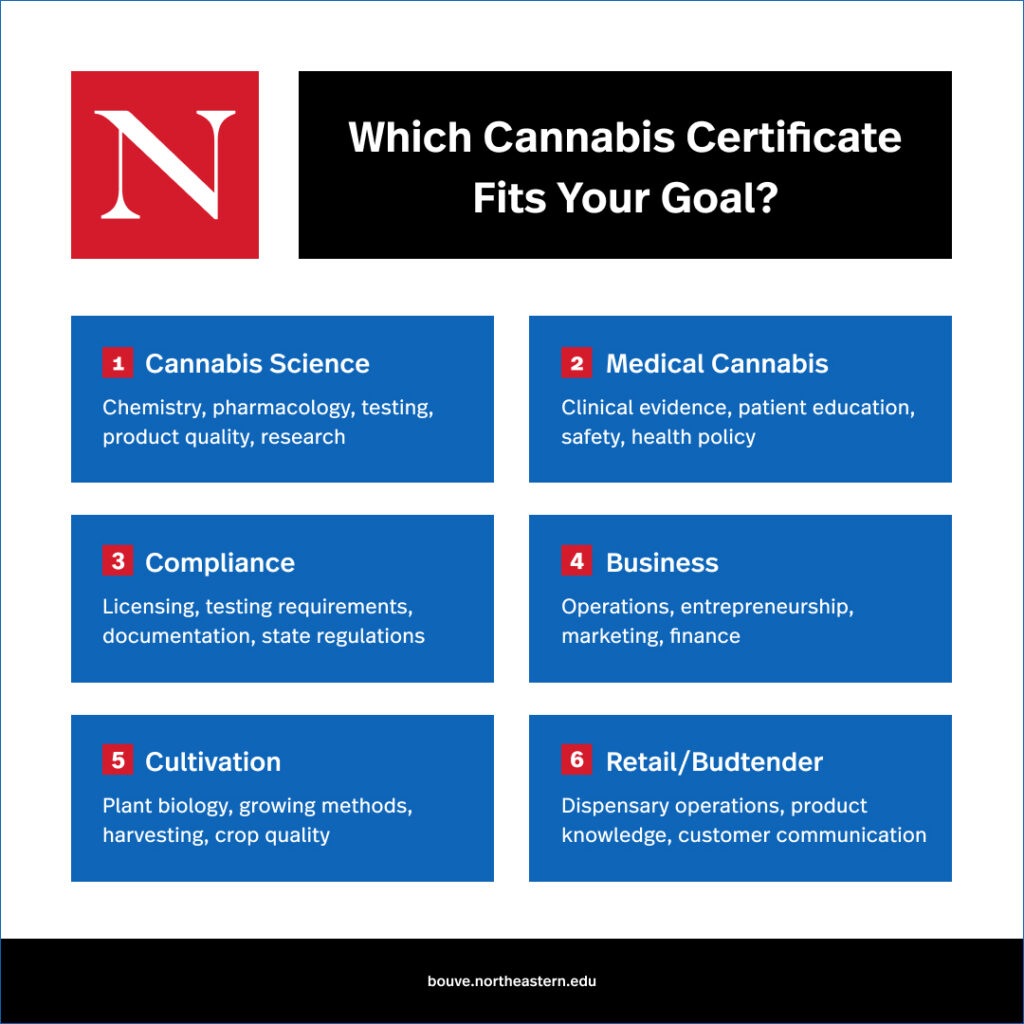
Cannabis Science Certificates
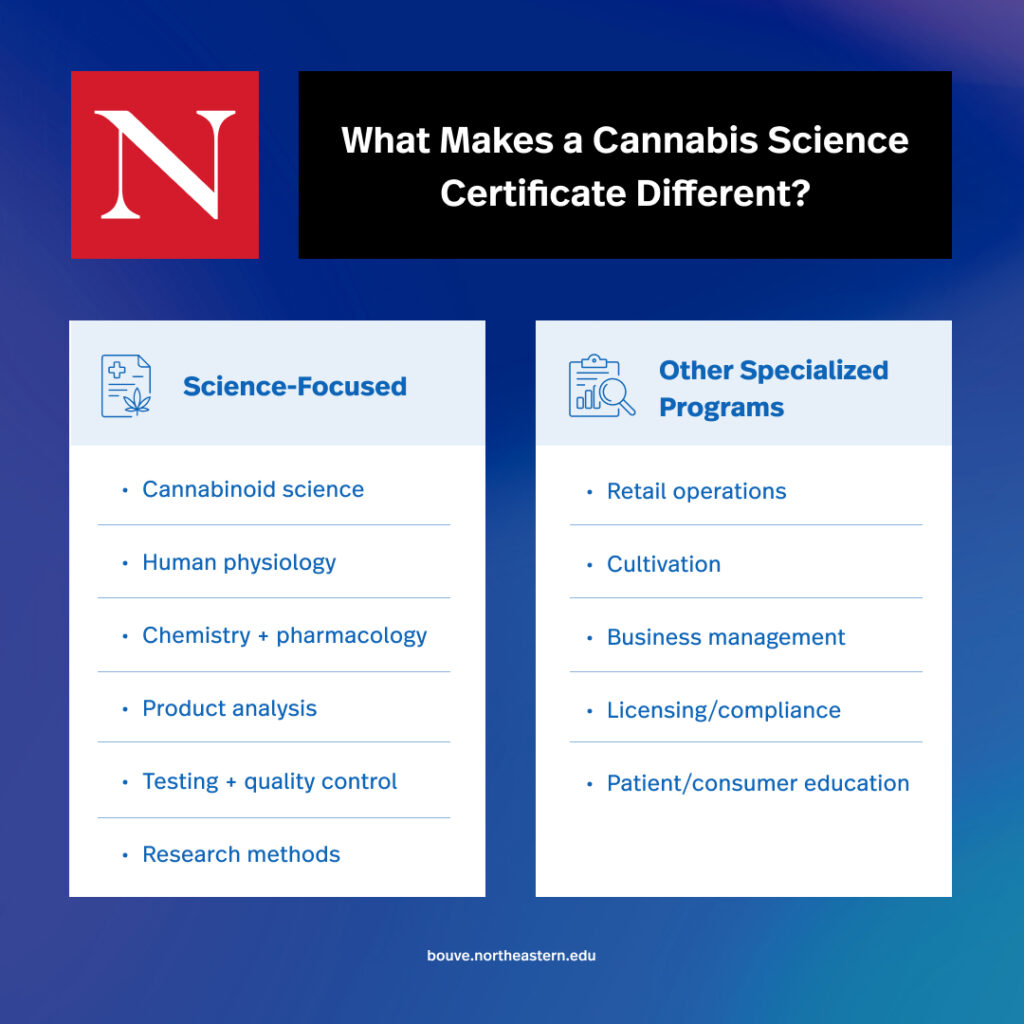
A cannabis science certificate takes an analytical approach, exploring the history of cannabis use, its chemical and biological properties, and theories about its capabilities. Cannabis science also examines the endocannabinoid system, including endogenous cannabinoids, receptors, and enzymes, as well as how plant-derived or synthetic cannabinoids may interact with that system.
Curriculum may include other topics such as:
- Human physiology
- Chemistry and pharmacology
- Product analysis
- Testing and quality control
- Therapeutic applications
- Law and policy
- Research methods
- Product development
Depending on the program, coursework could also cover cannabis-related law, policy, and business topics, as is the case with Northeastern University’s Cannabis Science Graduate Certificate.
For those only seeking training in cultivation, entrepreneurship, or basic retail practices, a science-oriented program may not be an ideal fit.
Medical Cannabis Certificates
Medical cannabis certificates focus on the scientific, clinical, legal, and educational dimensions of cannabis and cannabis-derived products in health-related contexts. A typical program may examine conditions or symptoms being studied, the quality of available evidence, safety considerations, patient education, and regulatory context.
Other curriculum topics may include medical cannabis laws, patient education, risks and safety considerations, and healthcare communication. Certificates for medical cannabis are best for professionals in healthcare-adjacent roles or learners interested in patient education, medical cannabis policy, or clinical implications.
Shields reflects on their own experience working with medical cannabis: “Cannabis saves lives on a population scale. It is a huge harm reduction mechanism. If you have the right education and intention and you understand quality, it’s a very personalizable experience and medicine.”
They continue: “It gives people a lot of self-determination and a lot of autonomy, and specifically amongst people who have chronic issues that have no other treatment options or very limited treatment options. It is a gamechanger for your quality of life. I love being a part of that as a job and as an industry.”
When comparing programs, it’s crucial to distinguish between medical cannabis education and medical marijuana card certification. Some “medical cannabis certification” language may refer to the process of getting approved for medical cannabis use as a patient rather than academic education.
Cannabis Compliance Certificates
Cannabis compliance certificates focus on government and industry supervision of cannabis products. Programs usually cover state regulations and licensing requirements and the best procedures for navigating audits and inspections.
From a quality control perspective, certificate programs discuss safety standards for growing and handling cannabis and product testing rules in labs. Companies that sell cannabis-derived products also need to learn accurate recordkeeping, inventory tracking, packaging, and labeling to ensure all products and sales practices are compliant.
As Shields points out, compliance is one of the more structured parts of the cannabis industry, but rules vary significantly by state. “Every state has its own regulator. Every state that goes legal establishes its own set of rules for how it will do the standardization of potency, which is THC percentage, but then also microbial testing safety, etc. So every state has its own set of standards.”
Compliance certificates are most beneficial for learners interested in legal markets, licensing, product tracking, testing requirements, documentation, risk management, and regulatory standards for cannabis.
It is a gamechanger for your quality of life. I love being a part of that as a job and as an industry.
Cannabis Business Certificates
Cannabis business certificates provide instruction on running a commercial business that sells or processes cannabis products and services. Business owners need specific knowledge on how to manage cannabis operations that comply with licensing and regulatory requirements and promote products using legally acceptable language.
A typical program also covers entrepreneurship topics such as business planning, marketing, market analysis, finance, and retail strategy. Business certificates are intended for people interested in dispensary ownership, commercialization, cannabis operations, marketing, or finance. As a result, these certificates may not offer deeper scientific training.
Cannabis Cultivation Certificates
Cannabis cultivation certificates provide botanical knowledge about planting, harvesting, and processing cannabis. While it incorporates plant science and horticulture, the focus tends to be highly specific to producing the best cannabis crop quality or specific cannabis hybrid strains.
Cultivation programs typically cover plant biology, growing methods, cultivation environments, and harvesting. Students also learn about pest management techniques and drying and curing methods for better crop quality. Learners interested in plant care, cultivation management, horticultural facility operations, agricultural production, and plant genetics benefit most from cannabis cultivation certificates.
Although cultivation certificates discuss plant science, they differ from cannabis science certificates because they do not focus on how the plant interacts with human biology or the chemistry of developing other cannabis-derived compounds. Similarly, science-focused programs like Northeastern’s certificate include cultivation in the coursework but not as a primary topic.
Retail or Budtender Certificates
Retail and budtender certificates provide training for customer-facing retail roles. Budtenders work in dispensaries caring for sales-floor inventory, handling transactions, staying up to date on industry trends, and educating customers about products.
Typical coursework emphasizes dispensary operations, product types, compliance basics, customer communication, and responsible and safe sales practices. While a budtender could have more advanced knowledge of cultivation or cannabis science, it usually isn’t required to perform this type of role.
Retail certificates are best for learners interested in dispensary work, customer service, product education, point-of-sale operations, and state retail rules. For those seeking graduate-level science, product testing, research, or policy depth, budtender education most likely won’t be a good fit.
General Cannabis Education Certificates
General cannabis education programs provide an industry overview for learners who want an introductory understanding of the cannabis market and the factors shaping it. While curriculum can vary, the most common topics typically include cannabis history, product types, legal basics, and consumer education.
A general certificate is best for those seeking broad cannabis literacy or continuing education without a highly specific career goal. This type of program may not provide enough specialization for technical or science-forward goals.
What Should You Look for in an Online Cannabis Certificate Program?
Cannabis education isn’t a standardized requirement across the industry, so people interested in cannabis-related fields have many options for building knowledge. Choosing a relevant education program allows learners to get the most value out of the investment and avoid an unnecessary commitment of time and resources. Consider the following factors as you search for online cannabis certificate programs that serve your needs.
Clear audience fit
Does the program overview define the target audience? Determine whether the certificate is designed for beginners, retail workers, business owners, science graduates, healthcare professionals, compliance professionals, or cannabis industry workers who want to further their career.
Curriculum depth
Does the program’s curriculum cover the specific subject areas you need? For example, a science-focused learner should look for cannabinoids, pharmacology, analytical techniques, testing, quality control, therapeutic applications, and regulatory context. A business-focused learner needs coursework about cannabis operations, market analysis, and compliance.
Keep in mind that certificate programs of a similar type can also vary in content. One program might cover more topics than another or include more depth while serving the same target audience. Look closely at the curriculum to ensure it offers the information and coursework you need.
Credential level
Is the program non-credit-bearing, undergraduate, graduate, continuing education, professional development, or certificate-bearing? Credential level determines the difficulty of the coursework and eligibility expectations for students who apply. Make sure you meet the educational or professional requirements to participate in the course and the credential strengthens your qualifications.
Faculty expertise
Who teaches the program? Do faculty have academic, scientific, clinical, regulatory, or industry experience? The cannabis industry is young and unstructured, making it crucial for people entering the field to learn from instructors who understand the technical and professional realities.
Shields likens the cannabis sector to the software industry in the 1990s—a landscape that’s filled with opportunity but largely undefined and evolving based on the work of industry pioneers. “It’s… competitive, and the companies are constantly fluctuating with the legal changes that happen. Money flow is also constantly changing, so the needs are constantly changing.”
Shields goes on to explain that professionals who are passionate about staying in the industry must be able to network, adapt, and pivot. Gaining applied knowledge from experts who have navigated industry challenges or transitioned between sectors can help learners develop resilience in their careers.
Institutional credibility
Is the program offered by a recognized university or institution? Shields emphasizes the importance of looking at the accrediting body and how the university is perceived overall. A credible institution typically has strong connections to experienced faculty, industry organizations, research facilities, and partner companies in the private sector.
A reputable program also ties the curriculum to real-world applications through projects, collaboration with industry partners, or both. “Northeastern’s biggest advantage is that they focus a lot on that interface with industry and academia versus a lot of other academic institutions that are purely academic,” Shields says.
Online flexibility
Can you complete the program while working? Does it offer part-time options? Is the learning format realistic for your schedule? For example, Northeastern’s online cannabis science certificate is available full time or part time and can be completed in as little as nine months. Consider whether the certificate program fits your lifestyle or will require significant adjustments.
Career relevance
Does the program help you move toward the roles or opportunities you care about? For science-focused learners, look for relevance to testing, quality control, medical cannabis, research, policy, product development, and industry leadership. A degree is often more beneficial for intensive research roles, while subject-specific certificates in cannabis retail, compliance, or business are ideal for professionals who don’t need deeper science training.
Northeastern's biggest advantage is that they focus a lot on that interface with industry and academia versus a lot of other academic institutions that are purely academic.
Questions to Ask Before Enrolling in a Cannabis Certificate Program
Working in an industry where specific education isn’t mandated for most roles gives you some autonomy in planning a career path. The more you define your goals, the easier it is to decide what type of training is necessary to expand your knowledge and skills.
Here are questions to consider before enrolling in a cannabis certificate program:
- What type of cannabis work do I want to pursue?
- Is the program designed for my background?
- Does the curriculum match my goals?
- Is the program science-focused, business-focused, medical-focused, compliance-focused, cultivation-focused, or retail-focused?
- Is it graduate-level, noncredit, continuing education, or undergraduate?
- Who teaches the courses, and what are their qualifications?
- Does the program explain costs and fees clearly?
- Can I complete it while working?
- Does the program help me understand state and federal regulatory complexity?
- Does it include enough scientific rigor for the roles I want?
- Will it help me gain knowledge I can actually apply?
As you explore options, recognize that the cannabis industry is vast with many non-linear entry paths. Ask yourself: Is this the right credential, or would a degree, shorter certificate, or industry experience be better? Current professionals in the industry often come from science, health, or business backgrounds or have personal experience with therapeutic applications.
If you want to build upon existing knowledge to grow in the cannabis industry, a certificate may be appropriate. If you want career flexibility beyond the cannabis industry, a degree that opens doors to other interdisciplinary science fields or research careers might be a better fit. Knowing your professional interests and education options will enable you to make a balanced decision.

Which Cannabis Certificate Program Should You Choose?
Due to the variety of career paths in the industry, there is no universally “best cannabis certificate.” The best program is the one that fits your background and goals and will aid in achieving your desired role.
For instance, a budtender certificate may suit your needs if you want to start working in retail within a relatively short period of time? A cannabis business certificate can help you leverage existing knowledge to start your own cannabis operation, manage a business, or market products.
For science-trained learners who want a rigorous online program, Northeastern’s Graduate Certificate in Cannabis Science offers a structured path into the scientific, therapeutic, regulatory, and product-related dimensions of cannabis. It may be especially relevant for students interested in research, medical and clinical applications, drug design, policy development, product innovation, testing, quality control, or career advancement in related fields.
Explore Northeastern’s Graduate Certificate in Cannabis Science to learn how the online program can help science-trained learners build a foundation in cannabis science.
Want to learn more about Cannabis Science Graduate Certificate?
Request more information about the certificate and any questions you might have.