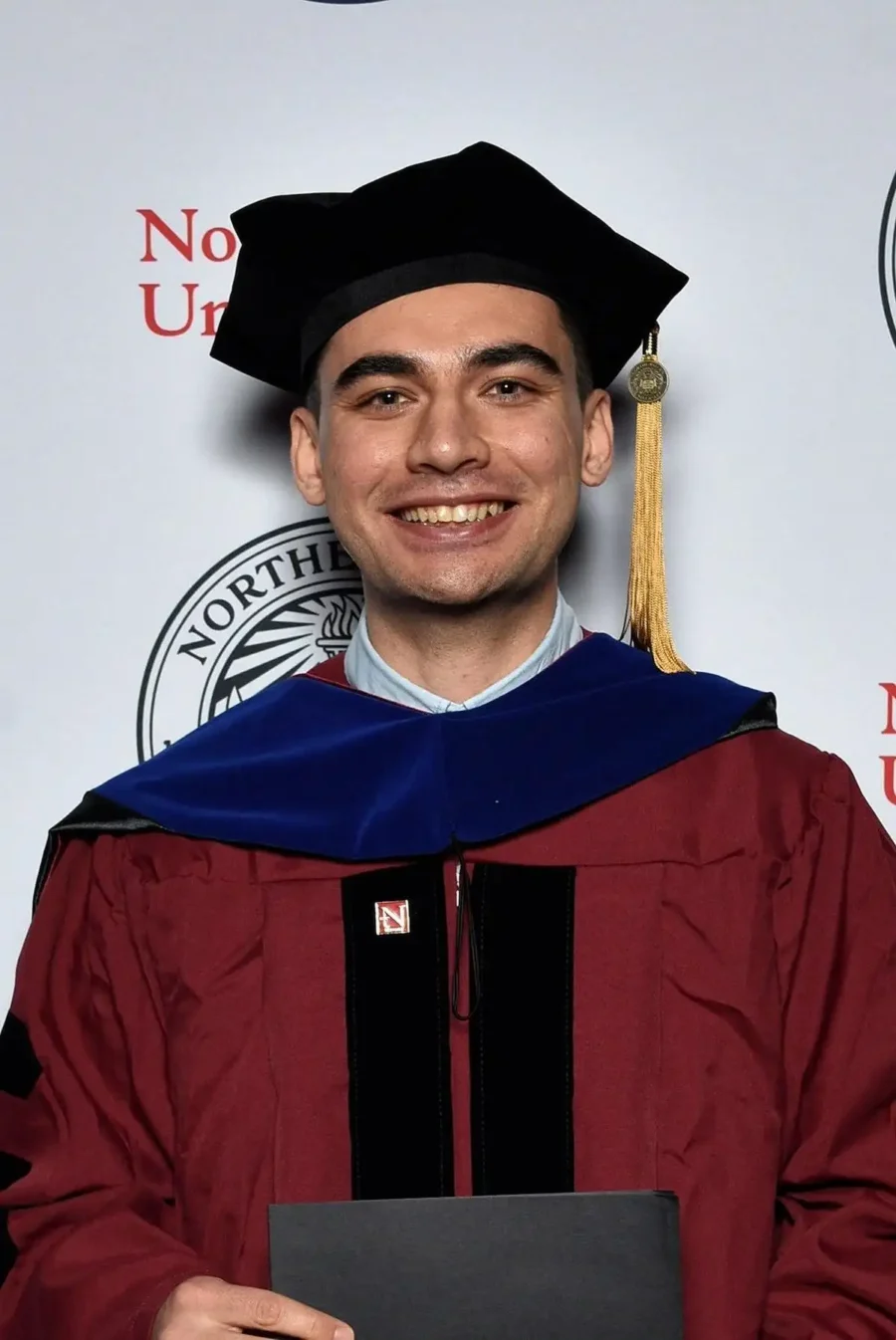
Dr. Farbod Alinezhad’s journey through Northeastern University’s Population Health PhD program demonstrates how the program’s unique flexibility can transform a medical professional into a cutting-edge researcher and industry leader. Now working as an economic consultant at a leading Boston firm, Dr. Alinezhad credits the program’s interdisciplinary approach and supportive environment for enabling him to develop skills he never expected to acquire.
Finding the Perfect Research Match
After completing his MD/MPH with a focus on health economics, Dr. Alinezhad was searching for a program where he could advance his research interests in healthcare competition. His decision to choose Northeastern came down to a crucial factor: finding the right mentor. When he discovered Dr. Brady Post’s research profile, he knew he had found his match. “His research matched my interests very well,” Dr. Alinezhad recalls, noting that his interactions with Dr. Post and Dr. Young during the application process were particularly welcoming.
Unprecedented Cross-Disciplinary Freedom
What sets Northeastern’s Population Health PhD program apart, according to Dr. Alinezhad, is its remarkable flexibility and breadth. “You are able to shape your path and create a very individualized program for yourself,” he explains. This flexibility allowed him to take courses across multiple departments, including economics, computer science, and health sciences—an opportunity that proved instrumental in forming his research ideas and gaining essential skills.
The interdisciplinary nature of the program enabled Dr. Alinezhad to pursue truly innovative research. His dissertation focused on the impact of vertical integration on healthcare, pioneering methods to use deep learning in causal inference—a level of cross-disciplinary work that is “quite rare in most programs.” The combination of machine learning, deep learning, advanced econometrics, and advanced biostatistics courses proved most impactful in shaping his research capabilities.
Exceptional Mentorship and Support
Dr. Alinezhad’s experience with faculty support was exemplary. “I couldn’t have asked for a more supportive advisor,” he notes, describing Dr. Post as always accessible, highly flexible regarding research ideas and methodological approaches, and understanding of his preferred pace for degree completion. The program’s collaborative spirit is exemplified by his dissertation committee, which included professors from health sciences, the business school, and the economics department.
The program’s commitment to student success extended to providing access to industry-leading computational resources. “We are talking about access to industry-leading computational resources for free for as long as you need,” Dr. Alinezhad emphasizes, noting this was crucial for his computationally intensive research.
From Academia to Industry Excellence
The program’s practical orientation and flexibility supported Dr. Alinezhad’s career transition seamlessly. He was able to complete an internship with his current employer while still a student, with the school providing full support for this professional development opportunity. He also participated in the LEADERS course, which he found highly informative for understanding industry applications.
Coming from a medical background without extensive technical and mathematical expertise, Dr. Alinezhad found the program transformative. “The skills and experiences I learned during my PhD are useful daily,” he reports. The program helped him develop capabilities far beyond his initial expectations—while he anticipated learning health economics and biostatistics, he also gained expertise in deep learning and advanced econometrics.
Dynamic Research Environment
Dr. Alinezhad particularly valued the dynamic nature of his research experience. He fondly recalls research meetings with his advisors where they would discuss methods and run analyses in real-time to make research decisions. This hands-on, collaborative approach epitomized the program’s commitment to active, engaged learning.
Multiple Career Pathways
The degree has opened numerous professional doors for Dr. Alinezhad. “The options are plenty,” he explains, noting that graduates can pursue academia or various industry paths including consulting, pharmaceutical companies, medical device companies, contract research organizations, and think-tanks. His own success in securing a position at a leading economic consulting firm demonstrates the program’s effectiveness in preparing students for competitive industry roles.
A Program That Delivers on Its Promise
When asked if he would make the same choice again, Dr. Alinezhad’s response is unequivocal: “100%. I could not have asked for a better environment.” His advice to prospective students reflects the program’s core strength: “You’ll be able to do whatever you have in mind as long as it’s healthcare related. There are no barriers.”
For Dr. Alinezhad, the key to success in the program is being self-driven and motivated, as students have significant agency in shaping their own experience. This combination of flexibility, support, and student empowerment has proven to be a winning formula, producing graduates who are well-equipped to tackle complex challenges at the intersection of health and technology.
Dr. Alinezhad’s journey from physician to economic consultant exemplifies how Northeastern’s Population Health PhD program can transform ambitious professionals into innovative leaders, ready to make meaningful contributions across multiple sectors of the healthcare economy.