
Professionals who enter the field of speech-language pathology have a unique opportunity: carve out a stable, high-earning career pathway while making positive impacts in people’s lives.
Whether it’s assisting a child with a severe stutter, helping a patient recovering from a stroke or working to devise new procedures to aid those with a swallowing disorder, speech-language pathology touches a wide variety of disciplines, requiring an equally varied skill set. Earning a master’s (MS) in speech-language pathology is the pathway to develop those skills.
Yet, returning to school and the commitment that requires, both in time and money, is daunting for many professionals. Will it pay off? What jobs can it unlock? How fast is the field growing? What industries employ SLP master’s graduates? Do classroom skills apply to real-world settings?
In the end, it boils down to one question: is it worth it?
Here, we’ll take a look at how an MS in speech-language pathology, like the one offered by Bouvé College of Health Sciences at Northeastern University, can put you on a path to higher earnings, stable career growth, provide opportunities in different industries, and allow you to positively influence the lives of others.
Is the Demand for SLPs Growing?
The short answer is, yes. There are several factors that account for why the need for speech-language pathologists continues to rise at a steady pace. Some of them include:
- Aging populations and medical advances: The largest drivers are demographic and clinical. People are living longer than ever before and medical advances mean individuals are more routinely surviving conditions that would, in the past, have shortened their lives. As such, needs related to communication and swallowing persist and often intensify. Labor market projections indicate that employment of speech-language pathologists will grow by 15% from 2024–2034, much faster than average.
- Earlier identification across childhood: Increased screening and earlier identification of language, literacy, and social-communication challenges mean more children are entering into services sooner than ever before. Earlier services don’t eliminate the need later; they often continue through school age, improving outcomes while maintaining steady demand.
- Broader awareness of SLP’s scope: From voice, fluency, and language to swallowing and cognitive-communication, SLP’s work spans the entire lifespan in nearly every healthcare and educational setting. That breadth fuels resiliency even when one sector slows.
- Telepractice is here to stay: BLS highlights telepractice as an expanding mode of care, particularly for schools, rural communities, and for medically-complex clients who benefit from hybrid care.
Sarah Young-Hong, the Program Director for Bouvé’s MS in SLP, has seen this demand increase in real time. “The need has only grown over the last 10 to 15 years,” she says. “Specifically, the baby boomer population aged and… we saw a greater need in those more geriatric spaces.”
As far as early intervention is concerned, Young-Hong cites the refinement of who is diagnosed as playing a big role in the growth for the SLP sector. “As [children] go through elementary, middle school, and high school… there’s more need there… I think things are being diagnosed maybe a little bit more frequently… more children being diagnosed with autism and with dyslexia and there’s just an increase in the understanding of what SLP is and what areas we treat.”
What Speech-Language Pathologists Earn
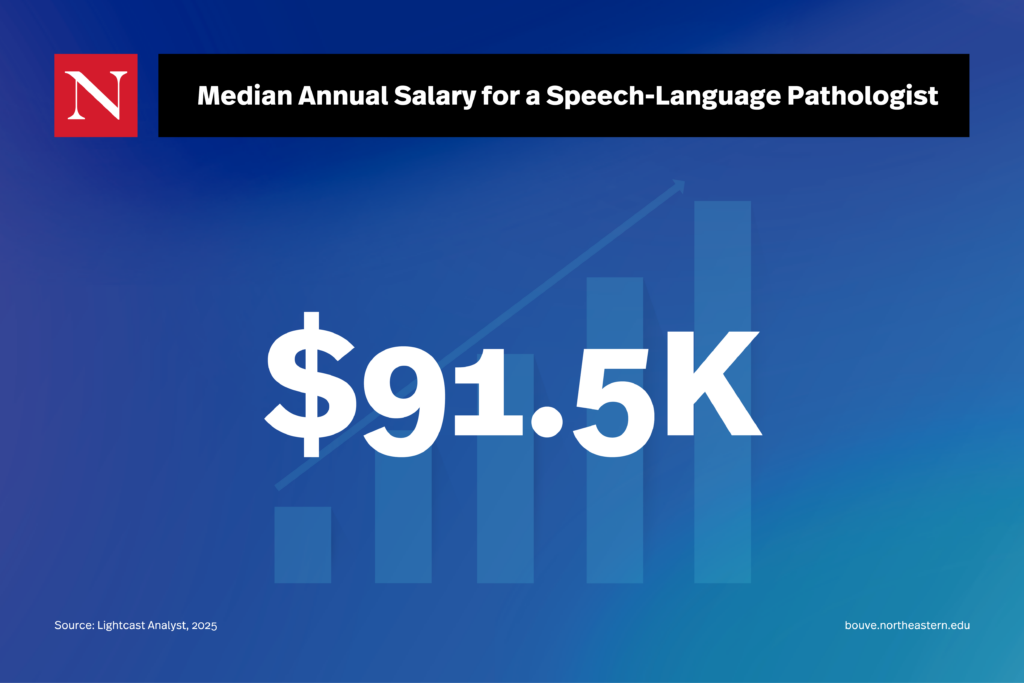
Those who earn their MS in speech-language pathology see earnings much higher than the national average. According to the Bureau of Labor Statistics, the national median annual wage for an SLP (May 2024) is $95,410, with the top quartile earning more than the median and higher pay clustered in medical and specialized settings and in certain metro areas.
ASHA’s 2024 Schools Survey shows a median academic-year salary of $74,849 and a median 12-month salary of $86,000 for SLPs, figures that align with the school schedule and benefits structure. In the healthcare industry, ASHA’s 2023 Health Care Survey reports higher salaries for SLPs working in hospitals and rehabilitation facilities, and clinicians often supplement their income through PRN or per-diem work as schedules allow.
In addition, there are about 13,300 job openings projected per year for the next decade. This can aid professionals with mobility or even provide leverage as they advance in their careers.
For students in the Southeast, Northeastern also offers its MS in Speech-Language Pathology at the Charlotte campus. The program gives students access to clinical training opportunities across North Carolina’s fast-growing healthcare and education networks—regions where demand for SLPs mirrors the national trend. With its location in a major medical and education hub, Charlotte provides graduates with strong placement potential and a pathway to meet workforce needs locally. For those weighing both salary outlook and job security, the Charlotte option demonstrates Northeastern’s commitment to preparing SLPs where they are most needed.
Where SLPs Work and Thrive
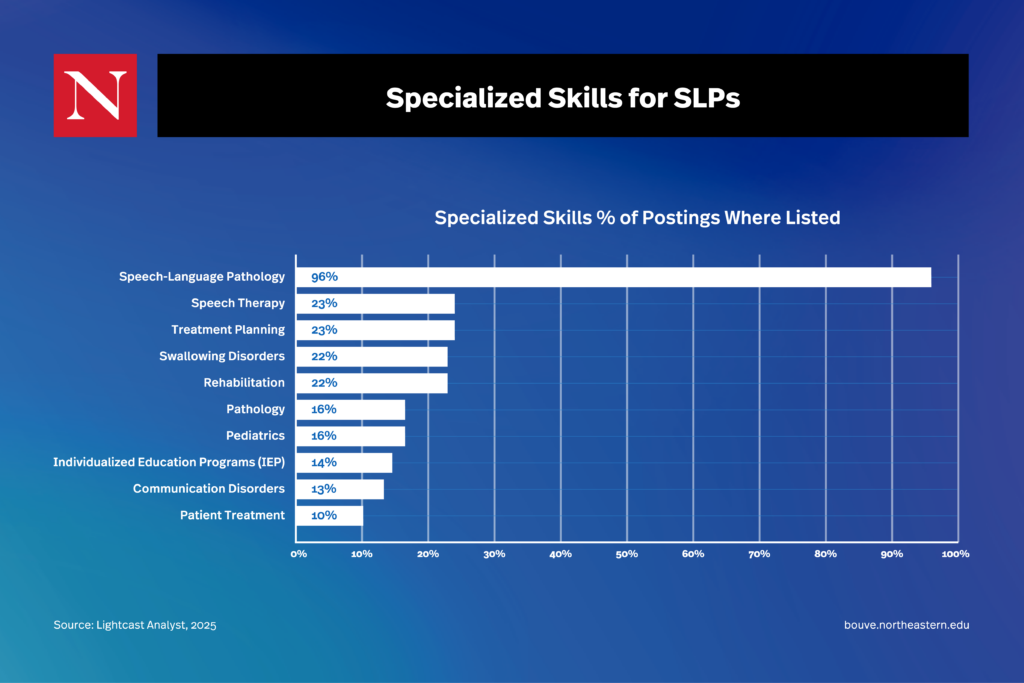
Those who attain an MS in SLP can expect to find employment in a variety of different fields. Speech-language pathologists are practicing in:
- K-12 schools
- Hospitals and rehabilitation centers
- Outpatient clinics
- Private practice
- Home health
- Early intervention facilities
- Skilled nursing facilities
- Research roles
- Academia
“Our scope of practice is pretty broad,” explains Young-Hong. “We treat across the lifespace—what I call birth to death or birth to geriatrics—and we work in pretty much every healthcare setting you can imagine. … We’re in early intervention; we’re in the elementary schools; the secondary school programs for 18 plus… dayhabs… and then we’re in hospitals both outpatient, inpatient, acute, subacute; we’re in nursing homes, and then there’s private practices.”
Typical Duties and Median Pay by Setting
In each of those areas, SLPs are taking on a variety of important roles. They can include:
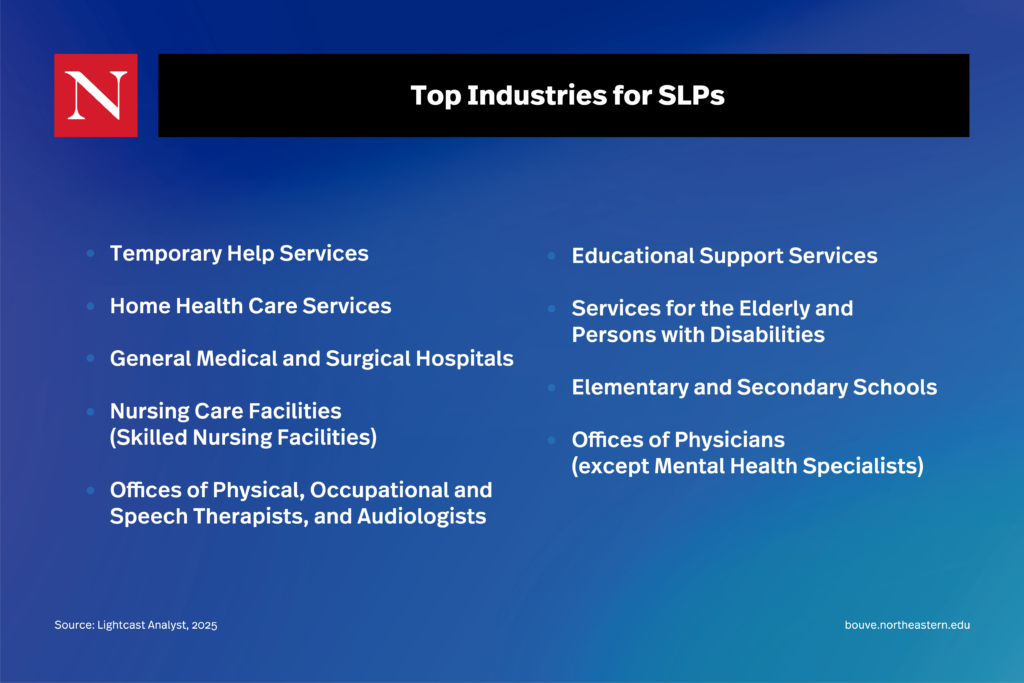
- School-Based Speech-Language Pathologist (K–12): In this role, a trained SLP would assess and treat articulation, language, fluency, and social-communication needs; help design and deliver IEP services; collaborate with special educators, psychologists, and general-ed teachers; manage screenings, progress monitoring, and family communication throughout the school year.
- Typical median pay (OOH, 2024) (Educational Services): $80,280
- Medical SLP — Hospital/Acute Care: SLPs in these positions evaluate and treat dysphagia, aphasia, voice, cognitive-communication, and trach/vent-related communication needs in ED, acute, and in-patient rehab units; participate in interprofessional rounds; provide instrumental swallow assessments (where credentialed) and intensive, short-stay therapy plans.
- Typical median pay (OOH, 2024) (Hospitals; state, local & private): $101,560
- Typical median pay (OOH, 2024) (Hospitals; state, local & private): $101,560
- Outpatient/Private Practice SLP (Clinic-Based): SLPs in these roles normally treat pediatric or adult clients in scheduled sessions; manage evaluations, treatment plans, and family training; coordinate with referring physicians and schools; may specialize in one area.
- Typical median pay (OOH, 2024) (Offices of PT/OT/SLP & Audiologists): $98,470
- Typical median pay (OOH, 2024) (Offices of PT/OT/SLP & Audiologists): $98,470
- Skilled Nursing Facility (SNF) / Long-Term Care SLP: Those working in an SNF will generally manage swallowing and communication disorders common after stroke, TBI, or progressive conditions; complete care-plan documentation; coordinate with nursing, PT/OT, and families across post-acute and long-term care stays.
- Typical median pay (OOH, 2024) (Nursing & Residential Care Facilities): $106,500
- Typical median pay (OOH, 2024) (Nursing & Residential Care Facilities): $106,500
- Home Health / Community-Based SLP (often including Early Intervention): In this capacity, SLPs provide therapy in clients’ homes or community settings; deliver caregiver coaching and functional, routines-based intervention (particularly in birth-to-three/early intervention); and document outcomes and coordinate with pediatricians and service coordinators.
- Typical pay (OEW, 2023): $56.10 median hourly (Home Health Care Services); $42.35 median hourly (Individual & Family Services)
Beyond the Paycheck: What Makes the Degree “Worth It” for Many
Of course, the bottom-line ROI is for most the key factor in deciding to pursue a master’s in speech-language pathology. But many professionals are looking for something more than the salary numbers. They are looking for benefits that go beyond their take-home pay.
Those benefits include:
- Career resiliency through choice: Students in programs such as Bouvé’s MS in SLP, train across all different areas of study, preparing them for a variety of opportunities both immediately upon graduation or down the road. That allows professionals to pivot in their careers as life changes, from acute care to schools, outpatient clinics to early intervention.
- Geographic portability: While SLP licensure is state-based, the national certification (CCC-SLP) and common training standards often facilitate the possibility of relocation.
- Entrepreneurial paths: Many SLPs ultimately move into private practice, telepractice, specialty clinics, or consulting, often after their experience in school or hospital settings have allowed them to build clinical depth and establish referral networks.
- Mission and meaning: Having the opportunity to help a child read with confidence, support a teen who stutters, or help restore someone’s ability to safely swallow after a stroke, are the personal impacts that many SLPs identify as the reason they stay involved in the profession.
“You get to build relationships with people, which is invaluable,” says Young-Hong. “We have a lot of students who are interested in science, they love the brain… They love solving the puzzle, figuring out what’s wrong and then figuring out how to fix it… to do it as a career and help people is very rewarding.”
Why Northeastern Stands Out
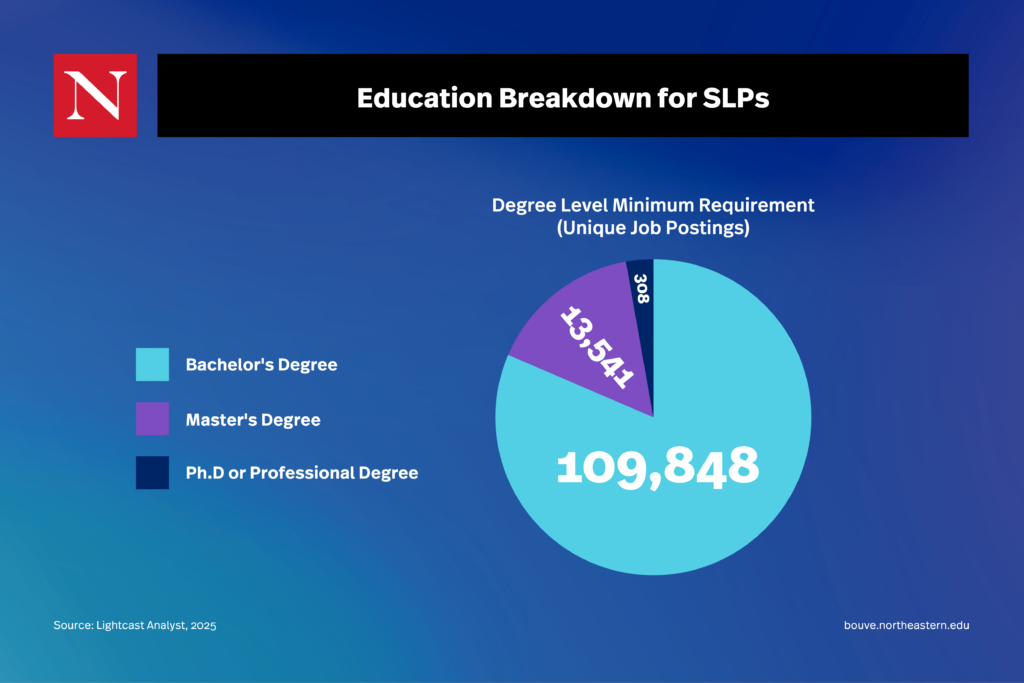
With an accredited, practice-forward curriculum, Bouvé’s 60-credit master’s spans both the science and clinic domains—neurology of communication, pediatric and adult disorders, dysphagia, AAC, voice, stuttering, research methods, and more—paired with four semester of hands-on clinical practicum in a variety of settings.
Two campus ecosystems
- Boston places you next to a dense healthcare and education network (and an on-campus Speech-Language and Hearing Center).
- Charlotte offers access to a fast-growing region and a community-serving Speech-Language Center (pro bono model), with strong demand for placements—“an untapped space,” Young-Hong notes, with a bustling clinic and waitlist that exposes students to real-world needs.
Early intervention & educator pathways
- Unique features include eligibility for state educator licensure and an additional certification in early intervention—ideal for students drawn to birth-to-school-age practice and available to students studying at the Boston campus.
Faculty mentorship with range and depth
Young-Hong describes a program culture that’s supportive and individualized: “No two students do the same thing…we capitalize on students’ strengths and set them up for success,” all while maintaining the flexibility the profession demands.
Considering your background? Northeastern outlines five prerequisite areas (e.g., phonetics, audiology, speech/hearing science) and accepts applicants from varied majors who complete the required coursework—common among career-switchers entering SLP.
Northeastern’s SLP Connect pathway is built specifically for career-changers and students without a CSD/SLP background, available on both the Boston and Charlotte campuses. It embeds the prerequisite “bridge” coursework into a six-semester master’s sequence so you can meet entry requirements while progressing toward the MS. In your first term, you select bridge courses (from five options) that cover core foundations before moving into the full graduate curriculum and clinical placements. The Connect option mirrors the program’s rigorous, practice-oriented training while opening an on-ramp for non-CSD majors.
So…is an MS in SLP Worth it?
If you’re motivated by people-centered science, want a career with mobility across settings, and value stable demand with six-figure potential as you advance, SLP checks the boxes. The typical SLP earns around $95K nationally; school-based roles provide calendar-year stability and benefits, while medical and specialized settings often pay more. With mindful budgeting (and potential scholarships), the degree can offer a compelling ROI—and a deeply meaningful day-to-day.
Explore Northeastern’s MS in Speech-Language Pathology in Boston or Charlotte, review prerequisites, and connect with admissions to map your pathway, and scholarships like the Charlotte SLP award (campus discount currently at 35%), open to any student applying to the Charlotte campus, whether for the traditional MS pathway or Connect.
Want to learn more? Download our free Career Guide for a more in-depth look at what to expect as an SLP. Ready to take the next step? Apply now and begin your journey today.