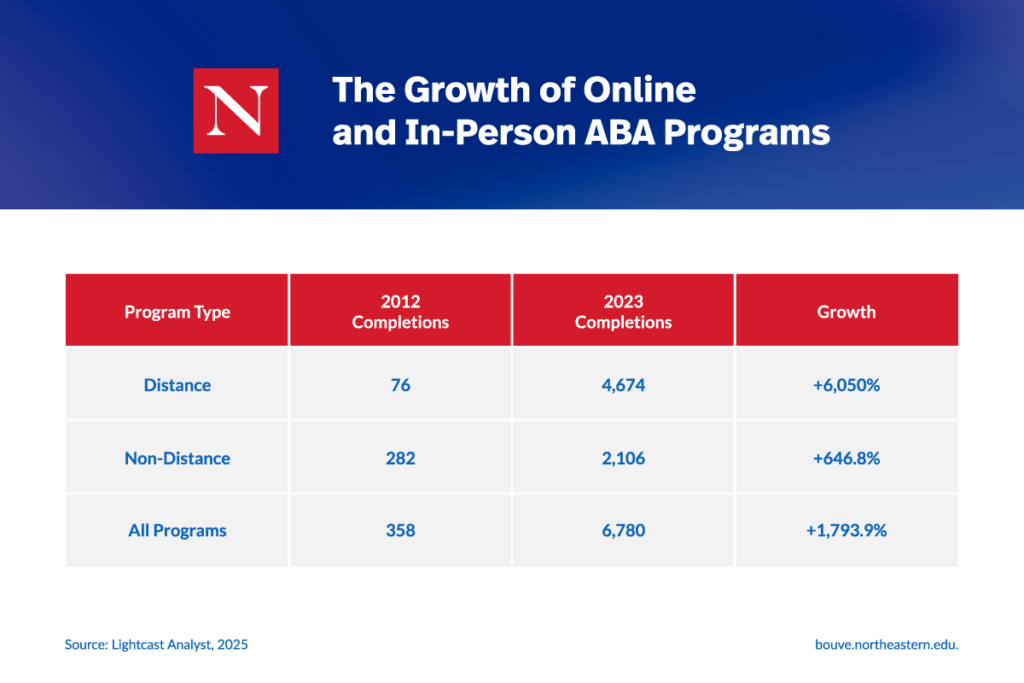
The field of applied behavior analysis (ABA) is experiencing rapid, unprecedented growth. Between 2023 and 2024, job postings for Board Certified Behavior Analyst (BCBA) rose by an impressive 58%, and related fields that employ ABA professionals are projected to experience significant growth. That positive outlook is, understandably, attracting more and more individuals seeking to enter an impactful profession, leaving many to ask, what provides the fastest route to becoming a BCBA?
Two of the most common routes are earning a master’s of science in applied behavior analysis or pursuing a graduate certificate in ABA. Both can lead to certification, but deciding which path to follow depends on your current situation, how quickly you want to become a BCBA, and what your future career intentions may be.
Here, we’ll try and answer some of those questions, such as:
- “What if you already have a qualifying master’s?” (A Graduate Certificate, with required fieldwork, is usually the fastest path.)
- “What if I don’t have that master’s degree?” (An MS in ABA is the quickest single credential to meet BCBA eligibility.)’
We’ll take a deep dive into what you can expect from a master’s program, a certificate credential, and why Bouvé College of Health Sciences at Northeastern University’s MS in Applied Behavior Analysis might be the best option for you.
Examining BCBA requirements
Before determining which path toward becoming a BCBA matches your preferences, it’s important to understand what, exactly, the Behavior Analyst Certification Board (BACB) requires. There are generally core criteria one must meet to be eligible to become a BCBA, including:
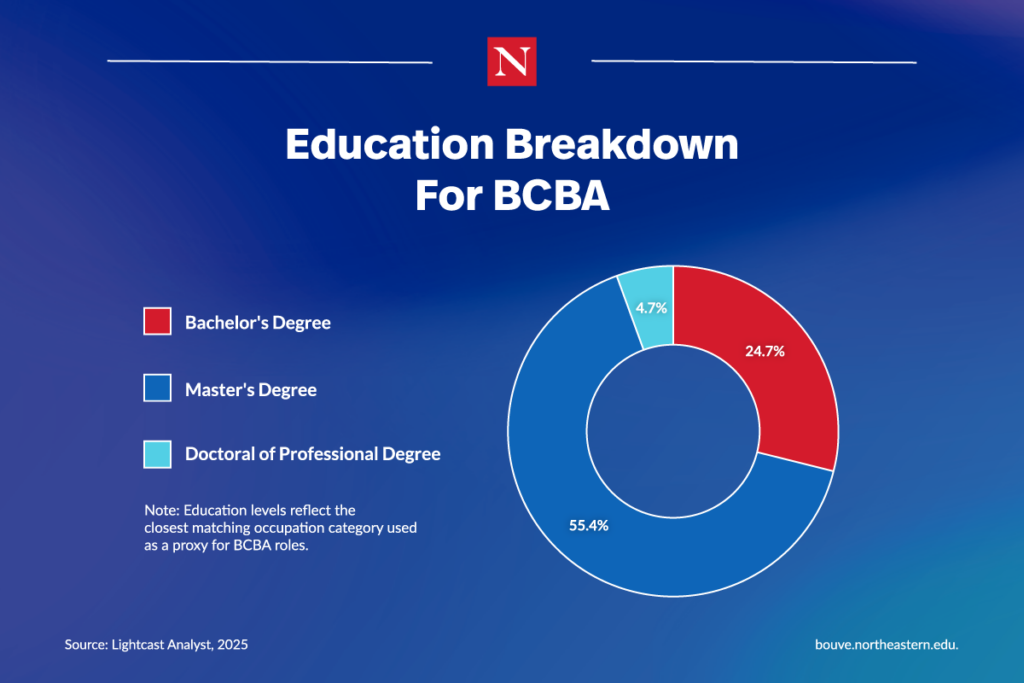
- A qualifying graduate degree – A master’s (or higher) from a qualifying institution (field may be in any discipline).
- Approved coursework – A total of 315 hours of graduate-level behavior-analytic coursework.
- Supervised fieldwork – Completing a set number of supervised hours utilizing ABA skills in practical settings is mandatory. All hours must be completed in five years and can be concentrated supervised fieldwork (1,500 hours) or standard supervised fieldwork (2,000 hours).
- Passing BCBA exam – The exam will be administered after all other requirements have been met.
It’s important to point out that those who already have a qualifying master’s degree can pursue a graduate certificate program that includes a BACB-approved VCS. However, for those who don’t yet have a qualifying degree, an MS in ABA is essential, not just for eligibility but also for career advancement and leadership readiness.
(Note: Beginning Jan 1, 2026, ABAI’s VCS system for Pathway 2 will be replaced by a BACB-managed coursework attestation. The course-by-course review ends, and non-verified coursework will no longer be accepted in BCBA applications.)
MS ABA or certificate: Which timeline is faster?
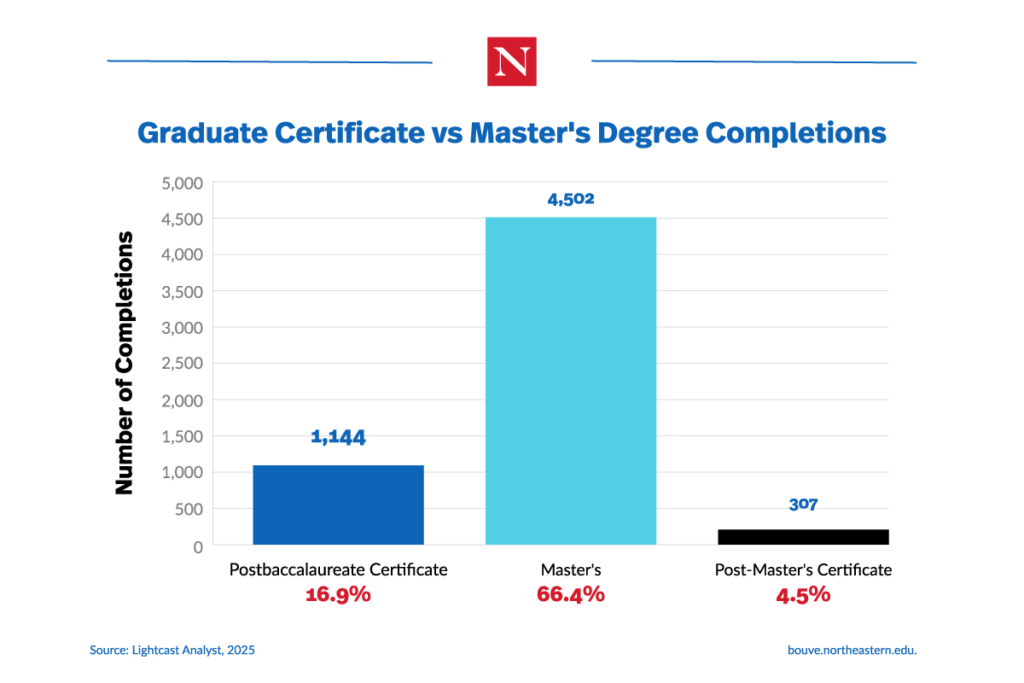
How quickly a professional can become a BCBA is a critical factor for many when deciding whether to pursue a master’s or a certificate. Typically speaking, these are the timelines for completion one can expect:
- Graduate Certificate: A graduate certificate program can normally be completed in approximately 12-16 months. The timeframe assumes the student enrolling already holds a qualifying master’s degree.
- MS in Applied Behavior Analysis: This program generally takes around 20-24 months (two years) to complete. It includes both the comprehensive coursework for the master’s degree and the specific ABA curriculum.
One thing to consider: For many, particularly those who do not meet the prerequisites for a graduate certificate program, an MS in ABA program may actually provide the faster route to BCBA certification as, pursuing a separate qualifying master’s degree and then a certificate program would take longer than a single, integrated MS ABA program.
Bouvé, for instance, offers its Online MS in Applied Behavior Analysis program specifically with flexibility in mind. The program features:
- Full-time and part-time study options to help busy professionals progress efficiently.
- An online asynchronous format with optional synchronous video discussions
In addition, Northeastern’s Charlotte campus offers opportunities for students in the southeastern U.S. to participate in local academic and professional communities—a substantial benefit to students given the strategic location in a growing healthcare hub. It also offers a hybrid model that Jane Carlson, director of the hybrid MS in Applied Behavior Analysis program at Northeastern’s Charlotte campus, has found to be popular amongst students.
“Our hybrid model is very specific,” Carlson explains. “Students take one course fully online, and the second in a hybrid format—with two weekend campus sessions per semester. The feedback I get is that they love the balance. It gives them a lighter load during the week and concentrated time with their professors.”
Who should choose the certificate path?
Whether or not someone should pursue a graduate certificate depends largely on their current educational credentials. The certificate can be ideal for someone who:
- Already has a qualifying graduate degree.
- Wants to add ABA credentialing to their existing professional expertise.
- Is seeking a focused, streamlined curriculum that skips foundational graduate coursework.
A graduate certificate program often focuses primarily on ABA coursework necessary for BCBA eligibility. Providing theoretical foundations and ethical guidelines for practicing ABA, it can be a wise choice for individuals who have already earned a master’s that meets BACB’s degree requirements.
Why the MS in ABA may be the better long-term investment
For those who do not yet hold a qualifying graduate degree, earning an MS in ABA can satisfy the degree requirement and—if the program’s curriculum meets Pathway 2 standards—the required 315 hours of behavior-analytic coursework. (You’ll still need to complete supervised fieldwork and pass the exam to be BCBA-eligible.)
The ideal candidates for the program would often be:
- Career changers who are transitioning into ABA from unrelated fields and do not possess a qualifying master’s degree.
- Those without a qualifying master’s and do not meet the specific BACB requirements for BCBA certification.
- Individuals seeking deeper knowledge regarding the principles and applications of ABA, including advanced research methods and ethical considerations.
- Professionals aiming for leadership roles, research, and advanced practice within the field, offering professional advantages beyond initial certification.
Many students enter the MS program after real-world exposure to the field. Carlson notes that “typically what I’ve been seeing is students who have a little bit of experience in the field (are coming into the program). So, they’ve gotten a first job working as a registered behavior technician…and went into those jobs not really knowing what they were about and then sort of fell in love with the field.”
Nicole Davis, Online Program Director – Applied Behavior Analysis Programs, at Bouvé College of Health Sciences at Northeastern University, adds that many students are personally connected to ABA before enrolling, as “a parent or sibling who has received services or may be receiving services” likely led to an interest in the field.
Did you know
Bouvé’s MS in Applied Behavior Analysis curriculum was updated and includes 8 core content classes, two experiential learning courses and two project-based (scholarly project) courses.The program culminates in a scholarly project, which is equivalent to a thesis, allowing students to gain valuable research experience.
Some courses also allow students a more direct say in class instruction. “Our theoretical course is built using an inter-teaching model where students ) work together on more complex readings and then send questions to the professor at the end,” says Davis. “The professor will create a lecture based on their questions as opposed to the other way around.”
Outcomes and outlook for BCBAs
The need for BCBAs has been on the rise over the last several years, with little evidence that demand will wane in the near future. Much of the demand is being driven by specific factors:
- Rising awareness of autism: Increased diagnoses leads to a higher need for ABA services.
- Effectiveness of ABA therapy: Proven success in various treatment applications has led to growing recognition.
- Expanded insurance coverage and legislation: Increased coverage for ABA services contributes significantly to job growth.
According to ZipRecruiter, the average BCBA salary is $89,075 per year (Aug 2025). The 25th percentile is $74,000, the 75th percentile is $90,500, and the 90th percentile is $132,500. Pay varies by state, with several (e.g., Washington, DC, New York) trending above the national average.
More reasons to consider Northeastern
In addition to asynchronous learning options and a program designed for the working professional, Bouvé College of Health Science at Northeastern University’s MS in ABA program features:
- Experienced faculty: The program is led by seasoned professionals with years of practical experience in the field.
- Strong reputation: Northeastern University’s robust academic reputation ensures a high-quality education and professional preparation.
- Built for the Future: The curriculum is designed to prepare students for the evolving demands of the ABA field, emphasizing long-term benefits and professional readiness.
“I chose the program at Northeastern because of its accessibility, its amazing professors, and how well it prepares you for the BACB exam,” explains Lilibeth Torres, MS in ABA ‘22. “I enjoyed the way the course has been structured in my three semesters of intensive practicum…Northeastern makes sure that its students are prepared for life post-graduation.”
Which path is the right one?
Which credential will get you to your goal of becoming a BCBA is dependent on a myriad of factors, and while pursuing a certificate usually takes less time, it may not be the best decision for those looking to earn their certification in as speedily a manner as possible.
Before making a decision, determine where you are as far as your education journey, where you want to go, and how much flexibility you’ll need to get there.
The Online MS in ABA program at Bouvé College in Health Science at Northeastern University, whether online or at the Charlotte campus, offers a flexible, reputable path to certification while preparing you for the next 10–20 years of your career, not just the exam.
If you want to learn more about this program, explore MS in Applied Behavior Analysis or contact admissions to talk through your goals and eligibility. For learners in the Southeast, learn how Northeastern Charlotte can bring this powerful program closer to home.