
Over the last decade, applied behavior analysis (ABA) has become a highly-valued skill set across numerous industries. While often associated with its role in autism therapy, industry leaders have increasingly recognized the need to employ the science-based principles of ABA to everything from organizational change to injury-reduction programs at the highest levels of sports.
As demand grows, so does the need for master’s-trained, Board Certified Behavior Analysts (BCBA).
But that raises important questions for professionals interested in entering the field. Will my earning potential justify the expense of the master’s program? Will I learn skills that can help with career resiliency? Can I count on the demand for BCBAs to continue?
In other words, is earning an MS in applied behavior analysis worth it?
When looking at everything from career paths, salary potential, networking opportunities, and professional outcomes, earning an MS in ABA clearly unlocks important doors, as programs like the Bouvé College of Health Science at Northeastern University’s Online MS in ABA prepares professionals to pursue new career paths now and in the future.
What is applied behavior analysis and why is it in demand?
Applied behavior analysis utilizes experimentally-verified principles—reinforcement, stimulus control, shaping, and more—to aid individuals and organizations reach important personal or professional goals. Autism services remains a core focus of this discipline, but ABA’s reach now includes:
- Education: Increasing literacy, math fluency, and classroom engagement.
- Behavioral health: Work on teams that treat anxiety, substance use, and feeding disorders.
- Organizational behavior management (OBM): Improving safety and productivity in business and industry.
- Emerging arenas: Environmental sustainability, sports performance, and human-AI collaboration.
Over the last decade-plus, demand for BCBAs has risen significantly, driven in part by the rising prevalence of autism spectrum disorder. The CDC now estimates 1 in 31 U.S. children are diagnosed with ASD, which represents a jump from similar estimates two decades ago—about 1 in 150.
Consequently, schools, clinics, and insurers now require more qualified professionals to design and supervise ABA programs.
“The success that we had even 40 years ago helped set the stage for the access to services that we see now. Many individuals receive behavior analytic interventions through medical billing, like they would any other physical or behavioral health service,” notes Jane Carlson, the Program Director of the Hybrid MS Applied Behavior Analysis at Northeastern’s Charlotte campus. “So there’s so much more access now, and that really has sparked a tremendous growth in the field and the need for people who are trained and certified.”
Career outlook—Is there demand for BCBAs?
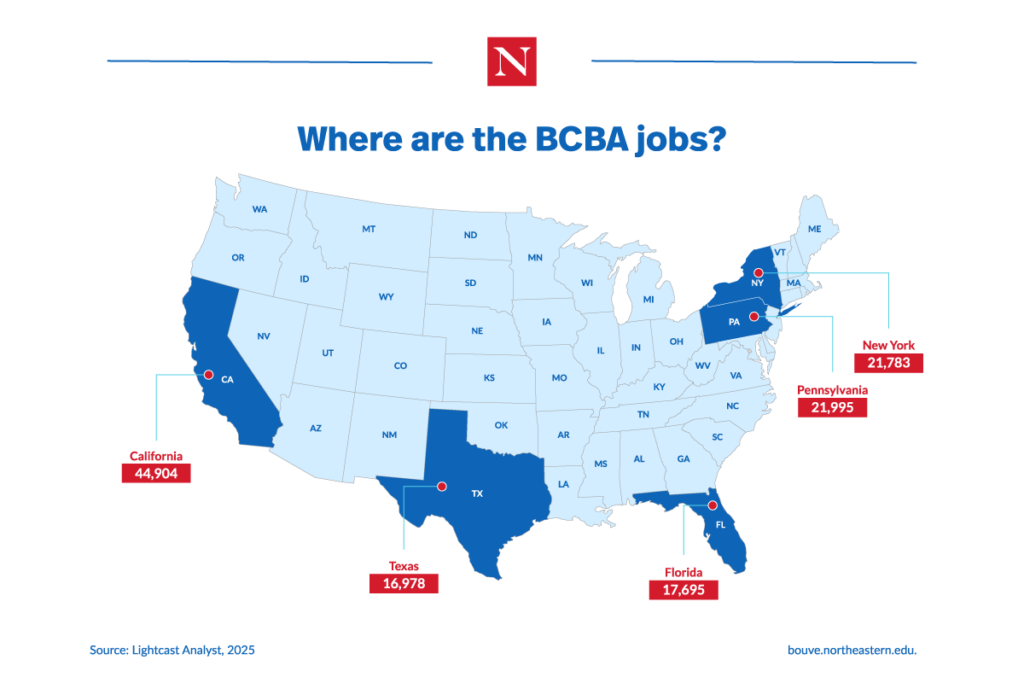
The rise in demand for BCBAs has outstretched the supply. A recent report from the Behavior Analyst Certification Board (BACB) found that annual nationwide demand for individuals holding BCBA or BCBA-D certification has increased each year since 2010, with a striking 58% increase from 2023 to 2024. That growth spans all 50 states, but some of the steepest increases have been seen in California, Massachusetts, Texas, New Jersey and Florida.
Roles that either prefer or require ABA skills and training, such as substance abuse, behavioral disorder, and mental health counselors, are projected to grow 19 percent between 2023 and 2033, which is more than three times the national average.
Expanding insurance mandates and school-based service requirements have also fueled consistent hiring pipelines.
“Behavior analysts are popping up anywhere humans learn and behave,” says Carlson.
What jobs can you get with an MS in ABA?
Earning an MS in ABA can position graduates for BCBA certification, which opens them up to a spectrum of possible roles—paving a pathway toward more earning power. It can also provide meaningful ROI beyond a salary bottom line. Those may include:
- Clinical BCBA: Design and oversee treatment plans in autism centers, pediatric hospitals, and home-based therapy.
- School-based BCBA: Implement positive behavior support, train teachers, and write individualized education plan (IEP) goals.
- Program supervisor or clinical director: Lead teams, manage quality assurance, and liaise with insurers.
- Research or data-analysis specialist: Evaluate intervention outcomes for universities, nonprofits, or healthcare systems.
- Behavioral consultant: Apply OBM principles to employee safety, customer experience, or change management.
- Innovative niches: Sports analytics, usability research, climate-related behavior change, or AI-driven decision support all utilize skills earned through MS in ABA programs.
Those numerous and varied opportunities, however, will have at their foundation the principles that guide all those who study ABA, as Nicole Davis, Online Program Director – Applied Behavior Analysis, at Bouvé College of Health Sciences at Northeastern University, explains. “(Students) enter the program (at Bouvé) learning about the concepts and principles that are the science of behavior. And in addition, they learn the ethical codes that all practitioners need to be bound by no matter how or where they’re practicing. Once they’ve got those tools in their toolbox, students can move forward with whatever they’re going to be doing.”
How much can you earn with a master’s in ABA?
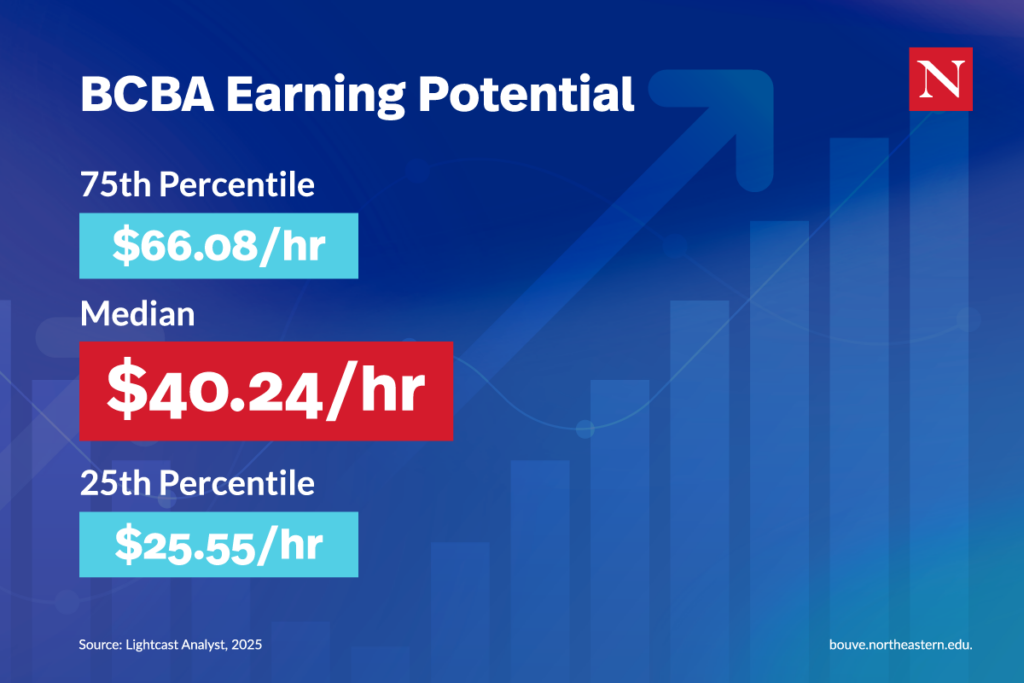
Determining your likely compensation will depend on a number of factors, including geography and experience, but typically, combining an MS with BCBA certification can substantially lift earning power over just having a bachelor’s degree or moving into technician roles.
Compensation for behavior-analysis–aligned roles varies by geography and setting, but recent Lightcast data shows that the 2024 U.S. median salary for Board Certified Behavior Analyst (BCBA) and Board Certified Behavior Analyst-Doctoral (BCBA-D) positions is $59,197, with those in the 90th percentile averaging more than $90,000 per year. Senior supervisory roles, specialized clinics (e.g., feeding) positions, and those within certain metro markets tend to sit higher within that range.
These averages do not take into account supervision responsibilities, advanced credentials (BCBA-D), and niche expertise (feeding clinics, OBM). Private clinics in major cities often offer hiring bonuses, relocation packages, and student-loan reimbursement to compete for talent.
Is an online MS in ABA respected?
Increasingly, students and professionals returning to school are looking for a high-quality online graduate education. As a result, modern-day employers and licensing boards are prioritizing program accreditation and student outcomes over course modality. Bouvé’s program, for instance, showcases that shift by focusing on:
- BACB-aligned coursework: Designed to fulfil the behavior analytic coursework requirement to pursue BCBA Pathway 2 eligibility
- Offers options to complete as much as 100% of the supervised fieldwork requirements towards BCBA eligibility for students.
- Established reputation: Northeastern has offered ABA training since 1976, making it one of the longest-running graduate programs in the U.S.
Non-monetary dividends of an MS in ABA
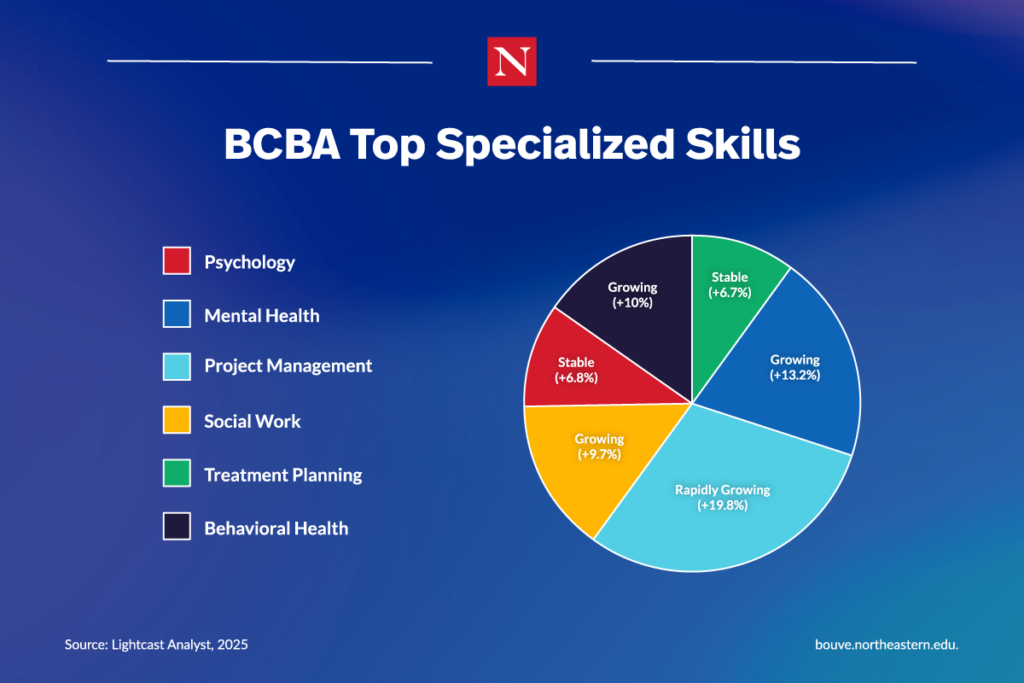
The value of the degree isn’t only financial. An MS in ABA invites professionals to add numerous important skills to their career skillset that can have an impact beyond just a salary bottom line. Those may include:
- Impact you can measure: ABA is relentlessly data-driven. You see what’s changing, why, and how to adjust. This provides an invaluable opportunity to measure success well beyond the “I think it’s helping” uncertainty.
- Career resilience: Demand for BCBA-supervised services are currently increasing, but the need for those services tend to remain steady across economic cycles because many are school-mandated or medically necessary.
- Professional autonomy: BCBAs design programs, lead teams, publish applied research, and supervise future practitioners.
- Interdisciplinary reach: ABA pairs well with healthcare, education, psychology, business, public health, and even AI and sustainability.
- Growth and curiosity: The field keeps evolving. “If in five to 10 years I’m not surprised by what’s happening in behavior analysis, I’ll be shocked,” Davis explains, reflecting on the pace of innovation.
“What we’re doing as behavior analysts in the applied setting is working on issues that are socially significant,” notes Carlson. Further, Carlson explains that the goal of a behavior analyst is to ask key questions, such as, “what’s important to that individual, to that group of individuals, to that particular area where we’re practicing and where we’re helping to create change in very important ways?”

The Northeastern advantage: What makes an online MS in ABA from Bouvé worthwhile?
When considering an online MS in ABA program, it’s important to weigh several factors that go beyond just cost. Reputation and certification alignment, the design of the curriculum, and the options to earn supervised fieldwork all contribute to the impact a program can have on student learning and career outcomes.
Some of what makes Bouvé so consistently attractive to ABA professionals is:
- Program structure and flexibility: The fully-online or hybrid nature of the program, with asynchronous delivery plus optional synchronous touchpoints so you can plan around shifts, childcare, and employment, is designed to allow for the busy professional to fit their educational pursuits within their schedule.
- Typical pace: Students commonly take 6 credits/semester over roughly 20 months (five semesters).
- Credits & alignment: The program requires 30 credits total. The coursework is aligned to BCBA Pathway 2.
- Supervised fieldwork options: Complete hours through your employer or via Northeastern’s Concentrated Supervised Fieldwork electives under faculty supervision.
“Life can be quite chaotic taking classes, while balancing a career and family,” says Carmen Susman, MS ’17. “I needed a master’s program that fit into my life that didn’t take away from the things that were important to me. That is why I chose Northeastern University’s MS in ABA program. The online format afforded me the time to reach my goals academically, continue on my career path, and spend quality time with my family. I would recommend Northeastern’s MS in ABA program to anyone, but particularly those balancing a family and career.”
Focus on the Charlotte campus
For those who are in the Southeast and would prefer a bit more face-to-face time, Northeastern’s Charlotte campus offers a primarily online but hybrid format that preserves flexibility while adding impactful in-person sessions.
Those enrolled in the program take two courses per semester—one is fully online while the other includes weekly virtual work plus two in-person weekends (Friday evening + Saturday) on the Charlotte campus. Students often report a “lighter weekly load” punctuated by concentrated faculty time on those weekends.
This hybrid model is designed to foster stronger local networking and mentorship—very useful when determining fieldwork placement and post-graduation roles in North Carolina and the broader region.
Carlson relates that students appreciate the cadence: “They like it because it gives them a little bit of a lighter load during the regular semester weeks… and then they get some concentrated time with the professor during those in-person weekends.”
Admissions & cost
Bouvé College of Health Sciences at Northeastern University requires 30 credits for graduation, at a per-credit cost of $1,439. That’s an estimated tuition of $43,170, exclusive of university fees.
Scholarships like Double Husky, Parent & Family, and Full Circle may reduce out-of-pocket costs for eligible students.
Secure your future career with an MS in ABA
Demand for BCBAs is strong and continues to rise. Those who can understand behavior and apply science-based principles to personal and professional goals are now taking on leadership roles in numerous industries. From the classroom and clinics to businesses, hospitals, and beyond, those with an MS in ABA can pursue a career where impact is visible in the data.
Bouvé College of Health Science at Northeastern University’s Online and Hybrid MS in Applied Behavior Analysis offers flexible online learning, faculty-supervised fieldwork pathways, and certification-aligned coursework grounded in the science. Those attending Northeastern’s Charlotte campus will also have the ability to take advantage of their Charlotte hybrid options.
If you’re ready to turn your passion into practice, take the first step today. Request info or start your application for Bouvé online MS in ABA.